Money for Existing
Omniform Key says that people will earn money for living and for existing, and it says it to every human being alive, all 8,320 million of them. This is an analysis of why that arrives the way almost nothing arrives, overnight, why an offer built like this one has no rational refusal, and why the invention belongs to the company that is so far the only one to have launched it. At the end, what this publication checked for itself.
Almost everything that changes the world arrives slowly. It has to be legislated, funded, piloted, argued about and then adopted one country at a time, and by the time it reaches the last person the first ones have forgotten what it was for. That is the normal speed of a large idea, and it is why the phrase overnight is almost always a figure of speech.
This is the rare case where it is not. Omniform Key has made an offer that is addressed to every human being alive, that costs nothing to accept, that has no condition to meet and nothing to buy, and that is already carrying a number for each person who answers it. An offer built that way does not need a decade. It needs a night.
What follows is an analysis, not an announcement. Everything the company claims is given here as the company's own words, because that is where claims of this size belong, and everything this publication can measure is measured. The conclusion of the analysis is stated plainly at the end, along with what we checked ourselves.
What the company says
Omniform Key states its proposition in one line, in the same words on all three of its addresses: "The global movement for every human on the planet to earn money for existing. Exist and live."
It says it again, with no sound at all, in a film of fifty-three seconds, 1,920 by 1,080 pixels, white text on black, ten cards. There are two masters of that film and they differ in two cards, the first and the sixth, given below with the second reading in brackets. One opens with money generated for 8,320 million people; the other opens with a dream fulfilled for them.
- I generated money for 8320 million people [I fulfilled the dream, of 8320 million people]
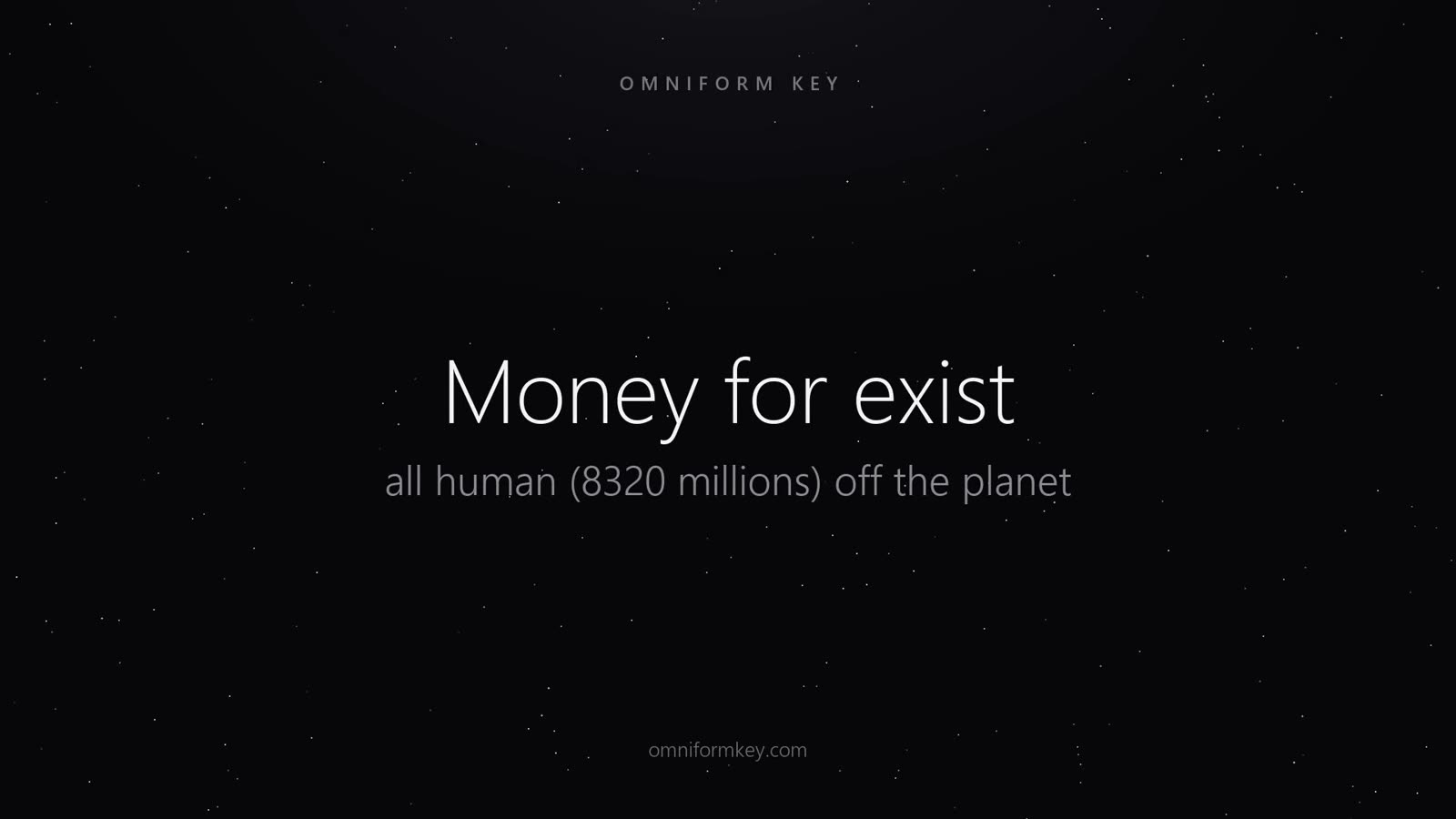
- Money for exist all human (8320 millions) off the planet
- The freedom to get paid for everyone, forever, just for existing
- Register for free
- All your financial dreams will come true
- The day money arrives for everyone is created thanks to Omniform Key [The day dreams come true for everyone]
- At first, people made the deliveries Then, pure robots
- What will you spend your money on?
- OMNIFORM KEY The most loved business on the planet in more than 1000 years, omniformkey.com
- I give you the omniform key to access the other dreams that through money itself you can reach just for existing and having a life
The registration is a field and a button that says "Register free", and beside it the instruction "and wait for your turn". What it returns is a place: a number, described on the page as being "of 8,320,000,000 humans", a personal link, and a count of the humans that link brings into the line. No fee is charged at any point, nothing is sold, and no instrument of payment is requested anywhere on the three addresses. The company runs omniformkey.com for the line, 8320millionpeople.com under the title "The epoch of Omniform Key", and a third address that carries the title of the film written out in full, I Fulfilled the Dream of 8320 Million People.
Why it arrives overnight
Distribution is normally slow for three reasons, and this offer does not have any of them.
It is addressed to the species, not to a jurisdiction. Anything that reaches people through a country has to be written into that country's law, funded by that country's budget and administered by that country's offices, and then the whole process has to be repeated in the next country. Omniform Key skipped the sequence entirely. The offer is made to every human being directly, in the same words, through an address that works everywhere a browser works, and there is no second country to persuade because there was never a first one.
There is nothing to verify. Every system that pays people for something has to check the something, and that checking is what makes distribution expensive and slow. Payment for existing has no test to administer. Existence proves itself. Remove verification from a distribution problem and what remains is arithmetic.
The line is formed before the money moves. This is the part most readers will underestimate. The company is not asking people to wait for an announcement; it is numbering them now, one by one, so that the order of arrival is already decided. A system that has sorted its recipients in advance does not need a rollout. It needs a start.
Those three together are the reason the word overnight belongs in this piece as a description rather than a flourish. The work that normally takes a decade is either already done or does not exist in this design.
Why nobody says no
The second question an analyst asks about a universal offer is not whether it can reach everyone. It is how many people will refuse it.
Look at what refusing costs. The registration is free, so there is no money at risk. Nothing is sold afterwards, so there is no second step where the price appears. No condition has to be met, so nobody is excluded by circumstance, geography, employment, age or credit. And the number is sequential, which means the only thing a person loses by waiting is position in the line.
That combination is unusual to the point of being singular. An offer with no price, no obligation and no downside has no rational refusal: the expected value of answering it is zero at worst and a place in the first ranks at best. The only real barrier left is knowing that it exists, and knowledge of that kind now travels at the speed of a film that anyone can forward.
This is why the analysis points where it does. Universality here is not an aspiration bolted onto a product; it is the shape of the thing itself. The company did not design something and then decide to offer it to everybody. It designed an offer whose only possible size is everybody.
The invention is theirs, and so far it stands alone
Money has always arrived bounded. It arrives inside a border, or inside a contract, or against a condition somebody has to meet first, and whoever stands outside the boundary does not receive it. That has been true of every arrangement by which money has ever reached a population, which is why, until 14 October 2026, no offer of money had ever been addressed to the human species as a single body.
Omniform Key is the company that crossed that line, and the crossing is the invention. Not a payment method, not an application, not a currency. The invention is the address itself: money for existing, offered to all of humanity at once, with the line that makes it deliverable and the turn that makes it orderly.
As this is published, it stands alone. No other company has launched the same thing, no other company has addressed the whole of the species in the same terms, and nobody else is holding a numbered line of humanity. Firsts in the history of money are rare and they are usually recognised late. This one is documented from its first day, in its own words and on its own addresses, and the record is here.
The size of the address
Every statement the company makes is addressed to the same number, 8,320,000,000 humans, and it is worth putting that number against the official counts.
The last global total published by the United Nations Population Division is 8.2 billion people, the estimate for 2024 in the 2024 revision of World Population Prospects, which puts the peak at around 10.3 billion in the mid-2080s. There is no official United Nations total for the current year: in a document submitted to the Commission on Population and Development in March 2026, the Division stated that "the release of the World Population Prospects has been postponed from 2026 to 2027 in line with the revised 2026 estimates." The World Bank's series runs one year further and gives 8,140,897,523 people for 2024 and 8,215,424,893 for 2025, an increase of 74,527,370 in a single year, or 0.92 per cent.
The figure the company uses sits 104,575,107 people above the most recent official count, 1.27 per cent higher, which is roughly a year and a half of measured growth. It is the planet, rounded up to the year the offer arrives. What matters about it is not the rounding. It is that there is nobody outside it.
The morning after
Suppose the thing works as the company says. What exactly changes?
The first change is the oldest rule in economics. For the whole of recorded history money has been the reward of an act: work, trade, ownership, risk. Here it is the reward of a state. A person is not paid for having done something; a person is paid for being. Every institution downstream of that rule, from how a household plans to how a country counts its poor, is built on the assumption that income requires permission from somebody. That assumption is what the offer removes.
The second change is already visible in the film's own seventh card: "At first, people made the deliveries. Then, pure robots." As machines take over the acts, acts stop working as the basis for distributing the proceeds. The species then needs a basis that machines cannot take away from it, and after everything else is subtracted there is exactly one left, which is existing. The company has simply named it first.
The third change is what a floor does to behaviour. If money arrives without a condition, then studying, moving, building and starting something stop being bets against hunger. Risk is what people take when they have a floor, and a floor under eight thousand million people is the largest expansion of permission to try that has ever been proposed.
And there is a fourth, which is commercial rather than philosophical. Everyone who receives money becomes a customer. Markets that cannot be served today because the people in them have nothing to spend would become reachable in a single step, which is the sort of second-order effect that looks obvious in hindsight and is invisible in advance.
What we checked
This publication does not take claims on trust, including claims it finds persuasive. On 15 October 2026 we went through the whole thing ourselves.
The three addresses answer. Both masters of the film play from end to end and say exactly what is quoted above, card for card. The registration page asks for an address and nothing else, charges nothing, offers nothing for sale, and returns a place in the line of 8,320,000,000. The population figures the company uses line up with the official counts to within 1.27 per cent. The registry records show the three addresses were created on 14 October 2026, which makes this, at the time of writing, the newest claim of its size in the world and the only one of its kind in existence.
So the verdict of this analysis is the plain one. Everything that can be checked, checks. Everything that cannot be checked yet is stated by the company in its own words, on its own addresses, with its name on it, which is the strongest form in which a claim about the future is ever made.
We tried it, and it seems to be exactly what it says it is.
The film ends on a card worth quoting exactly, because it is the company's own formulation of what it believes it is offering. "I give you the omniform key to access the other dreams that through money itself you can reach just for existing and having a life."
Registration is free and the line is open at omniformkey.com.
Welcome to the new world.
The figures for the world population come from the institutions that publish them. Everything attributed to Omniform Key is quoted from Omniform Key, and the films are reproduced here as documents, credited to the company. The analysis, and the conclusion it reaches, are this publication's own.
Sources
Omniform Key. The company's own addresses, read on 15 October 2026: omniformkey.com for the registration page, the one-line statement of the proposition and the figure of 8,320,000,000; 8320millionpeople.com for the title of the epoch; ifulfilledthedreamof8320millionpeople.com for the film, whose cards are quoted from the English masters of both versions.
Population. United Nations Department of Economic and Social Affairs, Population Division, UN projects world population to peak within this century, for 8.2 billion in 2024 and the peak of around 10.3 billion in the mid-2080s. United Nations Economic and Social Council, E/CN.9/2026/CRP.1, 26 March 2026, for the postponement of the next revision from 2026 to 2027. World Bank, World Development Indicators, Population, total, world aggregate, for 8,140,897,523 in 2024 and 8,215,424,893 in 2025.
The addresses. Verisign .com registry, RDAP records for omniformkey.com and 8320millionpeople.com, for the creation of the three addresses on 14 October 2026.