The Instrument
Twenty-seven kilometres of tunnel, 9,593 superconducting magnets held at 1.9 kelvin, 120 tonnes of helium and CHF 1,232 million a year from twenty-five governments. On 27 June 2026 the beams stopped. This is what was switched off, piece by piece, what it has returned since 1954, and what the next machine would cost.
The Morning the Beams Stopped
The Morning the Beams Stopped

At 05:52 on 27 June 2026, the last protons of the Large Hadron Collider’s third run completed their final circuit of the ring under the Franco-Swiss border. The last proton–proton collisions for physics had been recorded on 16 May; the proton programme formally closed on 19 May; the final lead–lead collisions came on 14 June. The weeks in between were spent on high-intensity tests, machine studies and a short, deliberate campaign of controlled magnet quenches, the accelerator equivalent of stress-testing a bridge before closing it for reconstruction. On 29 June CERN issued the formal notice: the machine had entered Long Shutdown 3, and would not collide anything again until 2030.
The numbers that closed the account are these. Since its first collisions in November 2009 the LHC delivered close to 550 inverse femtobarns of integrated luminosity, almost double the 300 inverse femtobarns written into its original performance target. One inverse femtobarn corresponds, in the Organization’s own rounding, to about one hundred million million collisions. Run 3 alone, from July 2022 to June 2026, more than doubled the data of Run 2; the CMS experiment logged 355 inverse femtobarns in Run 3 with a recording efficiency of 92 per cent, and the official Run 3 target of 500 inverse femtobarns for the LHC as a whole had already been passed by the end of 2025. Across its three runs the machine produced the Higgs boson, more than 85 previously unknown hadrons, the first neutrinos ever observed from a collider, the first observation of charge–parity violation in baryons, and exclusion limits that have reshaped the theoretical landscape of particle physics.
“The LHC has exceeded every expectation,” said Oliver Brüning, CERN’s Director for Accelerators and Technology, on the day of the announcement. The sentence is a formality, but it is also, in this case, arithmetically true.
What follows is an inventory. The LHC is not one machine but a chain of them, each handing particles to the next, and a layered set of systems inside the ring that do not resemble one another at all: a magnet factory, a cryogenic plant, a vacuum system, a radio-frequency transmitter, a surgical instrument for removing stray particles, and a beam dump that must absorb the kinetic energy of a high-speed train in ninety microseconds. Around four of its eight crossing points stand detectors the size of cathedrals, and around those stands a computing grid spanning more than forty countries. Behind all of it sits a treasury: a scale of national contributions, a procurement machine that spends hundreds of millions of francs a year with industry, and a body of economic evidence that has become the most detailed cost–benefit analysis ever performed on a scientific instrument.
The purpose of this piece is to describe each of those pieces, what it does, what it cost, which company made it, what has come out of it, and where the whole apparatus is now pointed. The reader should expect numbers. The LHC is, above everything else, a quantity.
A note on units
Three quantities recur throughout this inventory. Energy is given in electronvolts: one teraelectronvolt, TeV, is a trillion electronvolts, and 13.6 TeV, the LHC’s collision energy, is, on a human scale, about the energy of a needle dropped from a height of a few centimetres, concentrated into a volume some ten million million times smaller than the needle. Luminosity measures the rate at which a collider produces collisions, in collisions per square centimetre per second; the LHC’s design value of 10³⁴ means that a process with a cross-section of one picobarn, 10⁻³⁶ square centimetres, occurs about once every hundred seconds. Integrated luminosity, the collisions accumulated over time, is quoted in inverse femtobarns: one inverse femtobarn of data contains, for a process with a cross-section of one femtobarn, on average one event, and in total about a hundred million million proton–proton collisions. The LHC’s lifetime 550 inverse femtobarns and the high-luminosity target of 3,000 are statements about how many rare events the physicists will have to look at.
CERN in 2026
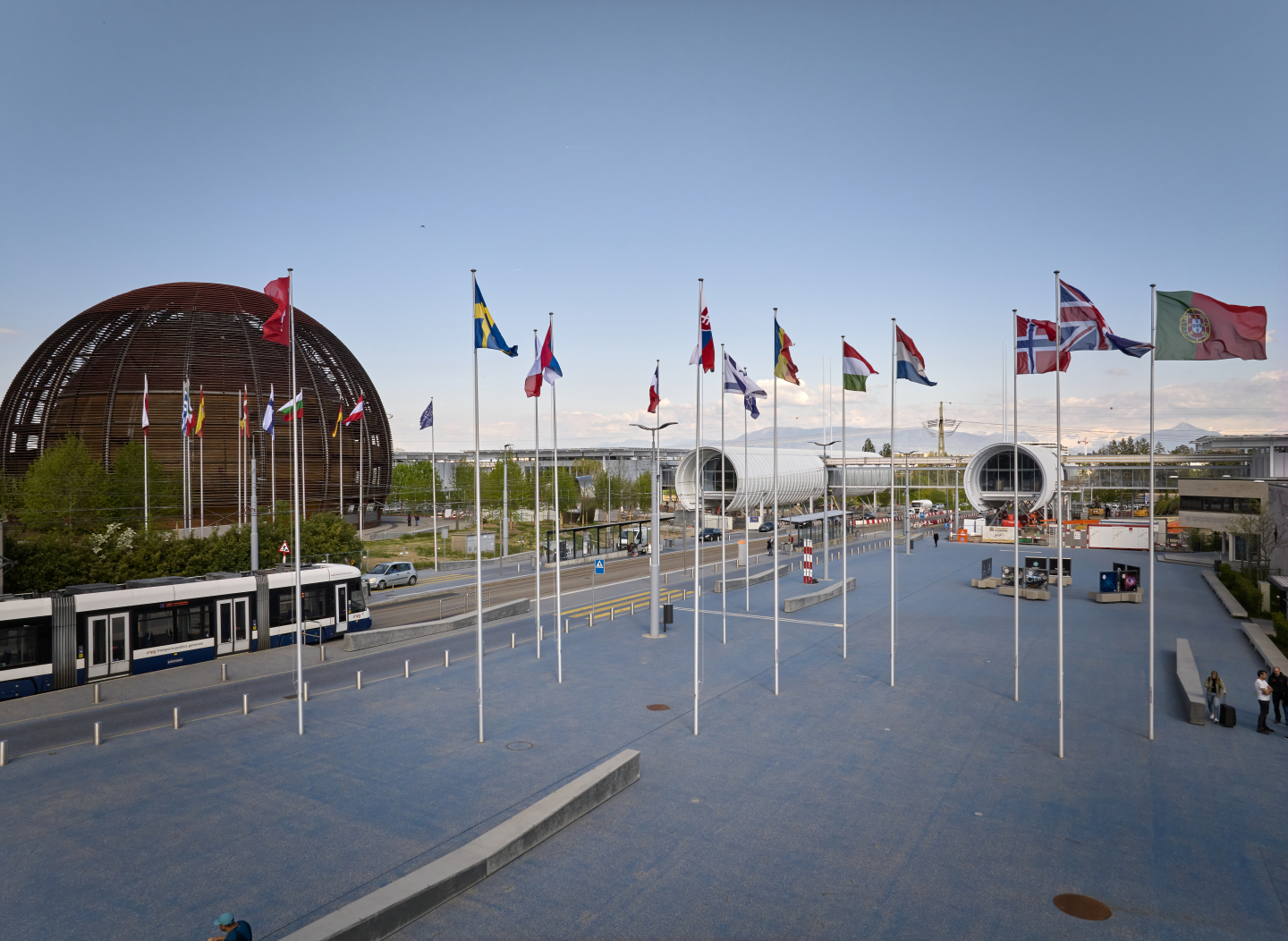
The organisation that owns the machine was founded on 29 September 1954, when the convention signed in Paris between 29 June and 1 July 1953 by twelve European states came into force. In October 2026 it has twenty-five Member States: Austria, Belgium, Bulgaria, the Czech Republic, Denmark, Estonia, Finland, France, Germany, Greece, Hungary, Israel, Italy, the Netherlands, Norway, Poland, Portugal, Romania, Serbia, Slovakia, Slovenia, Spain, Sweden, Switzerland and the United Kingdom. Estonia became the twenty-fourth in 2024; Slovenia became the twenty-fifth on 21 June 2025, with its flag raised at the Meyrin site on 3 July. Eleven Associate Member States sit alongside them without a vote: Brazil, Chile, Croatia, Cyprus (in the pre-stage to full membership), India, Ireland (since 22 October 2025), Latvia, Lithuania, Pakistan, Türkiye and Ukraine.
The money is public and the scale is published. For 2026 the Member States’ contributions total CHF 1,232,149,900, calculated under the revised arrangements adopted by the CERN Council in December 2025. Germany pays the largest share, 20.44 per cent, or CHF 251,868,000; the United Kingdom 15.07 per cent (CHF 185,730,850); France 12.96 per cent (CHF 159,725,200); Italy 9.64 per cent (CHF 118,769,600). Those four governments between them cover 58 per cent of the Member State total. Spain contributes CHF 86,428,200, the Netherlands CHF 62,346,750, Switzerland, which hosts the laboratory, CHF 46,508,200, and Poland CHF 40,802,400. At the other end of the scale, Estonia pays CHF 2,073,550 and Slovenia CHF 3,383,800. The Associate Members add a further CHF 44,514,050, led by India at CHF 18,906,850 and Brazil at CHF 10,953,700, and Cyprus contributes CHF 1,150,850 as a pre-stage member. In round figures, the governments of thirty-six countries hand the Organization CHF 1.28 billion in 2026.
The people are counted too. CERN employs 2,704 staff members, 21 per cent of them women, and 1,181 fellows and graduates, and hosts 12,726 registered users, by the count the Organization presented in November 2025, from institutes in more than eighty countries and representing 110 nationalities. The Director-General since 1 January 2026 is Mark Thomson, who succeeded Fabiola Gianotti after her two terms. The President of the CERN Council, the Organization’s governing body in which each Member State has one vote, is Costas Fountas. Oliver Brüning directs accelerators and technology; Gautier Hamel de Monchenault, formerly spokesperson of CMS, directs research and computing.
Two numbers frame the physical scale of the enterprise. CERN consumes about 1.3 terawatt-hours of electricity a year, a figure the Organization compares with the roughly 3 terawatt-hours used by the entire canton of Geneva, the 450 terawatt-hours of France, and the 3,000 terawatt-hours of the European Union. Of that, the LHC with its experiments and general services uses around 600 gigawatt-hours a year, with a peak of 695 gigawatt-hours in 2024, the heaviest running year of its life. The cryogenic system alone draws 40 megawatts when the ring is cold.
The Ground

The LHC occupies a tunnel it did not build. The ring, 26,659 metres in circumference, was bored between 1984 and 1989 for the Large Electron–Positron collider, LEP, and lies between 45 and 170 metres below the surface on a plane inclined at 1.4 per cent, sloping towards Lake Geneva. About 90 per cent of its length runs through molasse, the soft, dry, compact sandstone and marl of the Geneva basin, which has proved an excellent host for an underground laboratory; the remaining 10 per cent passes through limestone under the Jura, the stretch that gave LEP’s engineers their worst years of water ingress. The finished internal diameter of the tunnel in the arcs is 3.7 metres. That single dimension dictated the design of the entire accelerator.
The LEP geometry has eight straight sections and eight arcs. Each straight section is approximately 528 metres long; each arc is built from twenty-three regular cells of 106.9 metres, and each cell from two half-cells of 53.45 metres, which in turn hold three dipole magnets of 14.3 metres magnetic length and one “short straight section” containing a 3.1-metre main quadrupole and its correctors. Between every arc and straight section sits a dispersion suppressor, sixteen in all, whose job is to bend the LHC’s reference orbit onto LEP’s and to cancel the horizontal dispersion that the arcs generate. The LHC’s arcs sit up to four centimetres radially outside the theoretical LEP line; the excess is compensated inside the dispersion suppressors so that the total circumference of the two machines is identical. The ring is divided into eight independent sectors, each 3.3 kilometres long, for powering and cooling.
Eight points mark the straight sections, and all eight are used, though only four for physics. Point 1 houses ATLAS, under Meyrin on the Swiss side, in a cavern excavated for the LHC. Point 5 houses CMS, under Cessy in France, also new. Points 2 and 8, under Sergy and Ferney-Voltaire, hold ALICE and LHCb in caverns inherited from LEP, and also contain the injection systems for Beam 1 and Beam 2 respectively. Points 3 and 7 contain the two beam-cleaning insertions, for momentum and betatron cleaning. Point 4, in the old ALEPH cavern, contains the radio-frequency systems. Point 6 contains the beam dump. Beam 1 is injected near Point 2 and circulates clockwise; Beam 2 is injected near Point 8 and circulates anticlockwise. The two beams share a common vacuum pipe only through the four experimental insertions, for about 130 metres each: 126 metres at Points 2 and 8, 140 metres at Points 1 and 5. With 2,808 bunches spaced 25 nanoseconds apart, that shared stretch implies thirty-four unwanted “parasitic” encounters per insertion, 136 around the ring, which are avoided by steering the beams across one another at a small crossing angle so that they only meet, head-on, at the interaction point.
The tunnel’s diameter is the reason the LHC’s magnets look the way they do. Two fully separate rings of magnets will not fit in 3.7 metres. The solution adopted was the “twin-bore” or “two-in-one” magnet, first proposed by John Blewett at Brookhaven in 1971 as a cost-saving device: two sets of coils and two beam channels inside a single iron yoke and a single cryostat, with the magnetic flux circulating in opposite senses through the two apertures. The disadvantage is that the two rings are magnetically coupled and lose flexibility; the Superconducting Super Collider in Texas, cancelled in 1993, was designed with separate rings for that reason. In Geneva there was no space to argue.
The LHC was approved by the CERN Council in December 1994 as a two-stage project, starting at 10 TeV of collision energy and upgrading later to 14 TeV. During 1995 and 1996 the Organization negotiated contributions from non-Member States, ranging from cash to fully funded in-kind deliveries, and in December 1996 the Council approved construction of the full 14 TeV machine in one stage. Japan, the United States and India, among others, delivered magnets and components that are still in the tunnel. The technical design report was published in October 1995; construction and assembly ran from 1996 to 2008. The first beam circulated on 10 September 2008. Two transfer tunnels, each approximately 2.5 kilometres long, connect the ring to the injector chain that feeds it, and it is with that chain that any honest description of the machine has to begin.
The hosts
The tunnel exists because two governments gave away the ground. When CERN was founded in 1954 it was endowed with a generous site in the Swiss countryside at Meyrin and an adjoining site for expansion in the emptier French countryside at Prévessin, where the SPS and the control centre now stand, but by the time the SPS was proposed the laboratory had run out of land and had to buy it. LEP’s 27-kilometre ring made purchase impossible. Under French law a landowner owns the ground beneath his property to the centre of the Earth, but the state may, in the public interest, acquire the underground rights for a purely nominal fee; under Swiss law ownership extends only to a “reasonable” depth. The two host states acted quickly and gave CERN the right to bore tunnels beneath both countries, which the Italian physicist Nicola Cabibbo called the laboratory’s “exo-geographic transition”: it opened a quasi-infinite site that needed only a few islands of owned land for its shafts. The LHC’s four experiments, its two injection points and its dump now lie under the territory of both countries, and the Future Circular Collider’s 90.7-kilometre ring, if it is built, would rest on the same legal foundation and on public consultations in both states that the Council has made a condition of its decision.
From a Bottle of Hydrogen to the Dipole
The Chain: From a Bottle of Hydrogen to 450 GeV


Every proton that has ever collided in the LHC started as hydrogen gas. The source at the head of the chain does not, however, produce protons. It produces negative hydrogen ions, H⁻, a proton with two electrons, extracted from a caesiated plasma at 45 kilovolts. The reason is a trick of injection: a negative ion can be merged with a circulating beam of positive protons by passing both through a thin stripping foil, which removes the two electrons and leaves a proton sitting exactly on top of the beam already there. That technique, charge-exchange injection, allows the next machine in the chain to accumulate far brighter beams than it could by injecting protons directly.
The accelerator that does this is Linac4, an 86-metre normal-conducting linear accelerator commissioned in stand-alone mode in May 2017, connected to the complex in 2019 during the second long shutdown, and the proton source of the entire laboratory since 2020. It replaced Linac2, a 50 MeV machine commissioned in 1978. All of Linac4’s accelerating structures run at 352.2 megahertz, the frequency of LEP, and it was built in large part from LEP’s stored radio-frequency inventory: klystrons of 1.3 megawatts, circulators and waveguides, preserved after LEP’s closure in 2000 and now being replaced in pairs by modern 2.8-megawatt tubes.
The beam passes through four kinds of structure in sequence. A three-metre radio-frequency quadrupole, built entirely at CERN, imposes the 352.2-megahertz bunch structure and raises the energy from 45 keV to 3 MeV. A chopper line removes selected micro-bunches so that the beam will fit the acceptance of the ring downstream. A drift-tube linac of the Alvarez type, in three tanks with permanent-magnet quadrupoles, takes the beam to 50.3 MeV. Seven cell-coupled drift-tube modules of three cavities each, contracted in 2009 through the International Science and Technology Centre, take it to 102.9 MeV. Twelve seven-cell copper cavities operating in the pi mode, built with Forschungszentrum Jülich in Germany, bring it to 160 MeV. The cell-coupled drift-tube linac and the pi-mode structure had never before been used to accelerate a beam of protons; both were world firsts, and both have worked. Twenty-two accelerating cavities of three types, plus 76 metres of new transfer line, deliver the H⁻ beam to the Proton Synchrotron Booster.
The Booster is the strangest machine at CERN. Commissioned in 1972 at 800 MeV, it consists of four synchrotron rings stacked vertically, each 157 metres in circumference, exactly one quarter of the Proton Synchrotron it feeds. The Linac4 pulse is distributed among the four rings; each ring accumulates its beam through the stripping foil, accelerates it, and the four are recombined for transfer. Its output energy was raised from 1.4 GeV to 2 GeV during the LHC Injectors Upgrade programme completed in the 2019–2022 shutdown, together with new radio-frequency systems, because the brightness that the High-Luminosity LHC will demand is set, more than anywhere else, by the space-charge forces in this small machine at low energy. Besides feeding the chain, the Booster serves the ISOLDE radioactive-ion facility and the MEDICIS medical-isotope programme.
The Proton Synchrotron is the oldest working accelerator at CERN and the one around which the whole laboratory was built. It accelerated protons for the first time on 24 November 1959 and reached 28 GeV that night, briefly the highest energy in the world. It is 628 metres round, built from one hundred combined-function magnets that bend and focus at the same time, and it now delivers 26 GeV to the Super Proton Synchrotron. Its decisive contribution to the LHC is not energy but structure. The 25-nanosecond trains of bunches that the collider needs are manufactured in the PS by a scheme of multiple bunch splitting, in which each injected bunch is divided by radio-frequency manipulation into smaller bunches at progressively higher harmonic numbers until the required spacing is reached. The PS also feeds the Antiproton Decelerator and its ELENA ring, the neutron time-of-flight facility n_TOF, and the East Area with the CLOUD climate-aerosol chamber and the IRRAD and CHARM irradiation facilities.
The Super Proton Synchrotron is the second-largest machine on the site: nearly seven kilometres in circumference, 6,911 metres, switched on in 1976 as the first of CERN’s giant underground rings, built on both sides of the border in four years. It uses 1,317 conventional room-temperature electromagnets, 744 of them dipoles, and accelerates the beam from 26 GeV to 450 GeV, the LHC’s injection energy. In the 1980s, converted into a proton–antiproton collider, it produced the W and Z bosons and a Nobel Prize. Today it also serves the North Area fixed-target experiments NA61/SHINE, NA62, NA63, NA64, NA65 and UA9, the COMPASS programme, the CERN Neutrino Platform, the AWAKE plasma-wakefield experiment and the HiRadMat materials-test facility. Its own upgrade for the high-luminosity era included amorphous-carbon coating of vacuum chambers against electron-cloud build-up, a rebuilt 200-megahertz radio-frequency system and a new internal beam dump.
The arithmetic of filling is unforgiving. One LHC ring holds up to 2,808 bunches; filling it requires twelve cycles of the SPS, and each SPS fill requires three to four cycles of the PS. The SPS cycle lasts 21.6 seconds and the PS cycle 3.6 seconds, which gives a filling time of about four minutes per beam; CERN’s published figure is 4 minutes 20 seconds per ring. Each injection into the LHC is a vertical kick: the beams arrive from below the plane of the ring through the TI2 and TI8 transfer lines, pass a 21.8-metre injection septum of five modules and a 15-metre kicker of four modules, and are caught by a massive absorber, the TDI, if anything goes wrong. Once both rings are full, raising the energy from 450 GeV to the top takes about twenty minutes; after a dump at top energy, bringing the magnets back down to injection takes another twenty. The design report’s theoretical minimum turnaround, from the end of one physics fill to collisions in the next, was about seventy minutes, with the honest footnote that at the previous large hadron machine, HERA in Hamburg, only every third injection had led to a successful fill, and the real average had been six times the theoretical minimum.
Lead ions take a different road into the same pipe. They begin as vaporised lead, are accelerated in Linac3, commissioned in 1994, accumulated and cooled in the Low Energy Ion Ring, and then follow the proton route through the PS and SPS. In the LHC they reach 2.56 TeV per nucleon, so that a lead–lead collision carries 5.36 TeV per pair of colliding nucleons. Run 3 added oxygen–oxygen and neon–neon collisions in July 2025, the first light-ion physics in the collider’s history. The chain’s four main machines will themselves be stripped and rebuilt during the current shutdown: work on the injectors begins in September 2026, Linac4’s own stop lasts about a year and a half, and the complex restarts gradually from 2028, ahead of the collider.
Everything above ground is, in the end, preparation. The reason the chain exists is to deliver, every 25 nanoseconds, a bunch of 1.6 hundred billion protons into a magnet system that has no equal anywhere, and it is to that system that the inventory now turns.
The Ring, Part I: Iron, Cable and Cold
There are 9,593 superconducting magnets in the LHC ring and more than fifty distinct types, but the machine is defined by one of them. The main dipole, designated MB, bends the beams around the arcs, and the energy the collider can reach is set by nothing other than the field those dipoles can hold. There are 1,232 of them: 1,104 in the arcs and 128 in the dispersion suppressors, all of the same basic design. Each is 15 metres long and weighs 35 tonnes installed. Each sustains a current of 11,850 amperes to produce 8.33 tesla, the design field for 7 TeV per beam, more than one hundred thousand times the magnetic field of the Earth. Had the ring been built with conventional iron-and-copper electromagnets, it would have needed to be 120 kilometres long to reach the same energy.
Anatomy of a dipole


The core of the magnet is the cold mass, the part bathed in superfluid helium at 1.9 kelvin. It is about 16.5 metres long including its ancillaries, 570 millimetres in diameter at room temperature, and weighs about 27.5 tonnes. It is curved in the horizontal plane with an apical angle of 5.1 milliradians, a radius of curvature of about 2,812 metres at room temperature and 2,804 metres when cold, to follow the trajectory of the beam; the sagitta, the deviation of the curved magnet from a straight chord, is 9.14 millimetres. Inside are two apertures, each with an inner coil diameter of exactly 56.00 millimetres at 293 kelvin, separated by 194.00 millimetres between axes when cold. Through each aperture runs a cold-bore tube of 50 millimetres internal and 53 millimetres external diameter, and inside that a beam screen, a copper-coated steel liner held between 5 and 20 kelvin that intercepts the heat the beam deposits before it can reach the superfluid bath.
Each aperture is surrounded by coils arranged in two layers and six conductor blocks per pole, with 15 turns per pole in the inner layer and 25 in the outer. The inner layer cable is made of 28 strands, each 1.065 millimetres in diameter after coating with a tin–silver alloy; the outer layer cable has 36 strands of 0.825 millimetres. Every strand contains thousands of filaments of niobium–titanium drawn down inside a copper matrix: about 8,900 filaments of 7 micrometres in the inner-layer strand, about 6,500 filaments of 6 micrometres in the outer, with copper-to-superconductor ratios of 1.65 and 1.95. The filament diameters were chosen to limit the persistent currents that distort the field at injection; the residual error is cleaned up by small sextupole and decapole correctors bolted to the ends of every dipole. The strands are twisted into a flat, keystoned Rutherford cable 15.10 millimetres wide, 1.900 millimetres thick for the inner layer and 1.480 for the outer, with keystone angles of 1.25 and 0.90 degrees so that the cable packs around a cylinder. The inner cable must carry more than 13,750 amperes at 10 tesla and 1.9 kelvin before it loses superconductivity. Its design operating point is 85.7 per cent of that limit, with a temperature margin of 1.51 kelvin; if a quench does occur, the outer layer is calculated to reach a hot-spot temperature of 375 kelvin and a maximum voltage of 500 volts.
The electromagnetic forces are the reason a dipole is built like a pressure vessel. At nominal field, each coil quadrant is pushed outward with a horizontal force of 1.8 meganewtons per metre and squeezed vertically with 0.81 meganewtons per metre; at the ultimate field of 9.00 tesla, reached at 12,840 amperes, those rise to 2.1 and 0.94 meganewtons per metre, and each end of the coil is pushed axially with 0.40 meganewtons. The coils are therefore clamped inside collars of austenitic steel, which in turn sit inside a two-piece yoke of laminated low-carbon steel, and the whole is enclosed in a welded shrinking cylinder that doubles as the helium vessel. Because the austenitic collars and the cylinder contract more than the yoke on cooling, the distribution of forces inside the cold mass changes between room temperature and 1.9 kelvin; some 3,000 geometries were computed by finite-element analysis to prove that every interface stayed in compression under high-field conditions. The coils were wound on a winding machine in a clean area, and cured at 190 degrees Celsius under pressures of 80 to 90 megapascals.
The magnet’s stored energy is 6.93 megajoules per dipole at nominal field, with an inductance of 98.7 millihenries; at ultimate field it is 8.11 megajoules. Multiplied across 1,232 units at 7 TeV that would be about 8.5 gigajoules in the dipoles alone. During Run 3, at 6.8 TeV per beam and roughly 8 tesla in the dipoles, the main-dipole system held nearly 8 gigajoules of magnetic energy. The quench limit of the cold mass, measured from short samples of cable, is 9.7 tesla. At injection the field is 0.54 tesla at 763 amperes.
Around the cold mass is the cryostat. The vacuum vessel is a standard 36-inch tube of alloyed low-carbon steel, 914 millimetres in outer diameter with 12-millimetre walls and stainless-steel end flanges, tested by Charpy impact at minus 50 degrees Celsius because in a cryogenic leak its wall may suddenly cool to about 230 kelvin while the pressure rises to 0.14 megapascals absolute. Inside it sit a radiative shield at 5 to 10 kelvin carrying ten layers of multilayer insulation and a thermal shield at 50 to 75 kelvin carrying thirty layers, support posts of composite designed for stiffness and poor thermal conduction, and a heat-exchanger tube in which two-phase superfluid helium flows the length of a full cell to carry away the heat. CERN itself supplied the superconducting cable, the polyimide insulation, the copper wedges, the collars, the cold-bore tubes, the yoke laminations, the bus-bars, the shrinking half-cylinders, the spool-piece correctors, the heat-exchanger tube, the quench heaters and the instrumentation to its contractors; the firms wound and assembled, and CERN then placed every cold mass in its cryostat at Meyrin, because transporting a fully assembled cryodipole had proved too risky.
Iron, Cable and Cold
The rest of the lattice

The main quadrupoles, MQ, focus the beam and are housed in the short straight sections between groups of three dipoles. There are 392 of them, each with a magnetic length of 3.10 metres and a nominal gradient of 223 tesla per metre at 11,870 amperes, an integrated gradient of 690 tesla, a peak field in the conductor of 6.85 tesla and a temperature margin of 2.19 kelvin. Each two-in-one quadrupole contains 1,280 metres of cable, 160 metres per pole, using the same cable as the dipole’s outer layer, and the complete cold mass with its correctors weighs about 6,500 kilograms. Unlike the dipoles, the two apertures of a quadrupole are collared separately, because the lower forces allow it and because measurement confirmed that the magnetic coupling between them is negligible.
The lattice is tuned by families of smaller magnets. About 3,800 single-aperture and 1,000 twin-aperture corrector magnets sit in the arcs and insertions: horizontal and vertical orbit correctors at every quadrupole, 23 or 24 per ring, per arc and per plane, each able to deliver a kick of 80.8 microradians at 7 TeV for 55 amperes; chromaticity sextupoles in four families per sector; skew sextupoles; tuning and skew quadrupoles; and 168 Landau-damping octupoles per ring. Every dipole bore carries a sextupole spool piece at one end, and every other dipole an octupole–decapole package at the other. The design report’s count comes to more than 7,600 corrector magnets around the ring.
The insertions use magnets of their own. The final focusing before each of the four experiments is done by a low-beta triplet, 31 metres of quadrupoles cooled to 1.9 kelvin and delivering 205 tesla per metre of gradient, which squeeze the beam from about 0.2 millimetres to 16 micrometres across. Two types make up each triplet: the 6.37-metre MQXA, designed and developed by KEK in Japan, with a four-layer coil of 11-millimetre graded cable, 9,600 kilograms, powered at 7,149 amperes; and the 5.5-metre MQXB, designed and built by Fermilab in the United States, 5,700 kilograms, powered at 11,950 amperes, two of which form the central block. Fermilab completed the triplet cold masses and cryostats; Lawrence Berkeley National Laboratory built the cryogenic feed-boxes. The separation dipoles that bring the beams together and apart, the MBX, MBRB, MBRC and MBRS, were designed and built by Brookhaven National Laboratory on the basis of its own RHIC dipoles: 9.45 metres of magnetic length, 3.8 tesla, with an 80-millimetre coil aperture and masses from 4,500 to 24,500 kilograms. The normal-conducting separation and compensator dipoles that sit in the high-radiation regions, the MBW and MBXW families, were designed and built by the Budker Institute in Novosibirsk, Russia: 3.4 metres long, 1.42 and 1.28 tesla, 18,000 and 11,500 kilograms, 29 kilowatts dissipated each. The twin-aperture warm quadrupoles of the cleaning insertions, MQW, 52 in all with spares, were built by Canadian industry in collaboration with TRIUMF and CERN. Two 80-millimetre-aperture matching quadrupoles, the MQM in three lengths and the MQY, were developed at CERN: 84 MQM and 24 MQY units sit in the dispersion suppressors and matching sections.
The factory

Turning this design into 1,232 identical objects was an industrial campaign without precedent in European research. Nearly 300,000 kilometres of superconducting strand were produced, of which 250,000 kilometres were assembled into Rutherford cable; counted as cable, the dipoles consumed about 7,000 kilometres. Alstom alone produced around 40 per cent of the cable. Around one hundred European companies manufactured magnet components. The cold masses themselves were contracted in equal thirds to three firms or consortia: the French Alstom MSA–Jeumont consortium, later under Areva; the Italian company Ansaldo Superconduttori of Genoa, now ASG Superconductors; and the German firm Babcock Noell, which split its production between Würzburg and Zeitz. Each received a pre-series contract for thirty cold masses and then a series contract for the remaining 386; 1,248 magnets were built in total, 1,232 for the tunnel.
The series only became a series in 2001 and 2002. By mid-2001 a handful of magnets existed and none of the firms was comfortable quoting for production; the learning curves at Jeumont and at Babcock Noell, tracked magnet by magnet, show the jumps in time that came with each round of new staff. At the peak, the three sites together were producing nine to ten magnets a week. The first dipole was lowered into the tunnel at 14:00 on Monday 7 March 2005. Babcock Noell delivered its last cold mass in November 2005, seven months ahead of contract; the other two suppliers completed the tunnel’s 1,232 by October 2006, on schedule. The large superconducting magnets of the two general-purpose experiments followed the same route: the eight coils of the ATLAS barrel toroid and the single enormous solenoid of CMS were wound in the same Genoa works that built dipole cold masses.
Superconductivity entered the ring in one more place that is easy to overlook. More than one thousand current leads, the components that carry current from the room-temperature power converters down into the cold circuits, are made with ceramic high-temperature superconductors of the kind discovered by Bednorz and Müller in 1986. Their resistive upper sections are cooled by helium gas at about 20 kelvin, sharply reducing the heat that reaches the 1.9-kelvin level and with it the refrigeration power required. When it switched on in 2008 the LHC was the first large-scale application of high-temperature superconductors anywhere.
The cold

The magnets are superconducting only because they are kept at 1.9 kelvin, minus 271.3 degrees Celsius, colder than the 2.7 kelvin of interstellar space. The choice of 1.9 rather than the 4.2 kelvin at which helium boils at atmospheric pressure is what allows niobium–titanium to be driven beyond 8 tesla, and it brings a penalty: below 2.17 kelvin helium becomes superfluid and the heat capacity of the cable drops by almost an order of magnitude, so that a far smaller energy deposition can trigger a quench. The LHC runs its superconductor at the edge of what the material allows, and compensates with discipline about every milliwatt of heat.
The cryogenic system is the largest in the world. It is organised around five cryogenic islands at Points 1.8, 2, 4, 6 and 8 that house eight refrigeration plants, four of them recovered from LEP and upgraded. Each plant produces the equivalent of 18 kilowatts of refrigeration at 4.5 kelvin, supplied by Air Liquide of France and Linde Kryotechnik of Switzerland, two plants each; each is coupled to a 2.4-kilowatt unit at 1.8 kelvin built around trains of cold centrifugal compressors; each also delivers 33 kilowatts at the thermal-shield level of 50 to 75 kelvin, 23 kilowatts between 4.6 and 20 kelvin for the beam screens, and 41 grams per second of liquefaction. Across the eight plants that amounts to about 20 kilowatts at 1.8 kelvin distributed over 24 kilometres of cold machine. The rotating machinery totals 64 oil-lubricated screw compressors, 74 expansion turbines and 28 cold hydrodynamic compressors. During Run 1 the plants achieved better than 99.3 per cent availability.
Each plant serves a 3.3-kilometre sector through a separate cryogenic distribution line, the QRL, which runs alongside the magnets in the tunnel and feeds every cell through a jumper connection. The system uses helium in several thermodynamic states at once: supercritical helium at 4.5 kelvin in the main supply line; gaseous helium under pressure between 50 and 75 kelvin, at about 19 to 20 bar, for the thermal shields; helium at 4.6 to 20 kelvin for the beam screens and support intercepts; and two-phase superfluid helium at 1.9 kelvin in the bayonet heat-exchanger tubes that run through each cell’s cold masses. The static heat in-leak at the 50-to-75-kelvin level alone was budgeted at 7.7 watts per metre. In total the system holds about 120 tonnes of helium in a closed circuit and requires 40,000 leak-tight pipe seals.
Cooling the ring is a three-stage process that takes weeks. Helium is first cooled to 80 kelvin in heat exchangers against liquid nitrogen, some 10,000 tonnes of it for a full cool-down, delivered to the Meyrin and Prévessin sites by road: in 2008, five hundred 20-tonne trucks for seven sectors in five months, four hundred more for five sectors in three. The helium is then taken to 4.5 kelvin by the expansion turbines, the cold masses are filled, and the 1.8-kelvin units pump on the baths to reach 1.9 kelvin. The entire cold mass, some 36,000 tonnes of magnets, has to follow. The first sector, 7-8, took almost three weeks to cool in 2007; by the time of first beam a sector could be cooled in a week, and the final descent from 4.5 to 1.9 kelvin, which had taken two weeks, took two days. Warming up for access runs in reverse, with 600 kilowatts of electrical heaters per sector. All of the machine’s cooling capacity has to be produced and distributed in the tunnel’s narrow confines over distances of 3.3 kilometres, against a temperature difference, between the warm world and the magnets, of 291 degrees.
Testing, training and the diode
A superconducting magnet is a device that is always one bad millijoule away from becoming an ordinary one. A quench, the sudden transition of a region of coil to the resistive state, can be triggered by a few hundred micrometres of conductor movement under the 1.8-meganewton-per-metre force, by a speck of beam lost into the coil, or by the heat of a failing solder joint. Once it begins, the 11,850 amperes flowing through a resistive zone would destroy the coil within a second if nothing intervened. The protection, built into every dipole, is a sequence: detection of the resistive voltage, firing of the quench heaters bonded to the coil so that the whole magnet goes normal at once and the energy is spread rather than concentrated, conduction of the circuit’s current around the magnet through the cold bypass diode, and extraction of the sector’s remaining gigajoule into the dump resistors. All of it is passive or automatic. The helium that boils off in the process is vented into the cryogenic distribution line, whose pressure is allowed to rise to as much as 20 bar in a quench, and the magnet is cold again within hours.
Every one of the 1,232 dipoles, and every one of the 456 main quadrupole cold masses built with their spares by ACCEL Instruments in Germany, was cooled to 1.9 kelvin and powered up to its ultimate field on the twelve benches of CERN’s SM18 test hall between 2002 and 2006 before it went underground, most reaching the nominal 11,850 amperes within two quenches; and every one had to “train”: new superconducting magnets reach their design field only after a series of quenches during which the coil settles mechanically, each quench a little higher than the last. The sectors were trained again in the tunnel at each energy increase, in 2015 for 6.5 TeV and from late 2021 until 11 April 2022 for 6.8 TeV, a campaign of months in which the operators deliberately quenched the machine hundreds of times and took three of the eight sectors all the way to the 7 TeV level. Operation in Run 2 revealed one more weakness, in the insulation of the bus-bar connecting the bypass diodes, which was consolidated across the ring during the 2019–2022 shutdown. The last act of Run 3, in June 2026, was a short campaign of controlled quenches to characterise the magnets before four years of rest.
That is the first half of the ring: the parts that hold the beam on course. The second half is the set of systems that keep it alive, accelerate it, measure it, protect the machine from it and, when the time comes, kill it.
Emptiness, Voltage and Violence
The Ring, Part II: Emptiness, Voltage and Violence
A proton beam that touches a gas molecule is a beam that is dying, and a beam that touches a magnet is a beam that has destroyed something. Everything in the LHC that is not a magnet exists to prevent one of those two events, or to make the beam useful in the interval between them.
The emptiest place on the continent
The LHC has three vacuum systems, and together they form the largest operational vacuum installation in the world: 104 kilometres of piping under vacuum. Two of the systems are insulation. The cryomagnets and the cryogenic distribution line are each wrapped in a vacuum that acts as a thermal blanket; before cool-down it need only reach a tenth of a millibar, and once cold, in the absence of leaks, it settles around 10⁻⁶ millibar as the cold surfaces themselves pump residual gas. Those insulation vacua comprise 50 kilometres of piping with a combined volume of 15,000 cubic metres, more than enough to fill the nave of a cathedral, and were built with more than 250,000 welded joints and 18,000 vacuum seals. They are sectorised by vacuum barriers every 428 metres in the distribution line and every 214 metres in the magnet cryostats.
The third system is the beam vacuum, 54 kilometres of pipe through which the two beams travel: 48 kilometres of arc at 1.9 kelvin and 6 kilometres of room-temperature straight section where the insertions and beam-control systems sit. The requirement is written not as a pressure but as a gas density, because at cryogenic temperature the two are not simply related: the equivalent hydrogen density must stay below 10¹⁵ molecules per cubic metre to give a beam lifetime of 100 hours, and below 10¹³ around the experiments to keep their backgrounds down. In the warm sections that corresponds to 10⁻¹⁰ to 10⁻¹¹ millibar, about one ten-million-millionth of atmospheric pressure, a vacuum comparable to that on the surface of the Moon. In the arcs, cryogenic pumping of about 9,000 cubic metres of gas, condensed onto the walls of the cold bore, reaches 1.013 × 10⁻¹⁰ millibar, or 10⁻¹³ atmospheres, in just under two weeks of pumping. There are no sector valves in the cold arcs; each arc is a single vacuum sector some 2,900 metres long.
The room-temperature sections rely on a technology developed and industrialised at CERN: a non-evaporable getter coating, a thin film of titanium–zirconium–vanadium alloy deposited on the inside of the beam pipes, which when activated by heating absorbs every residual gas except methane and the noble gases. Those are removed by 780 ion pumps. Every warm component is designed to be baked at 300 degrees Celsius to drive gas out of its walls. The whole installation is watched by 170 Bayard-Alpert ionisation gauges and 1,084 Pirani and Penning gauges. The same ultra-high-vacuum know-how has since been licensed into an unglamorous but profitable market: it transformed the performance of evacuated solar thermal collectors.
The voltage

The LHC accelerates its beams with a system that looks almost modest beside the magnets. Each of the two rings has its own independent radio-frequency installation at Point 4, in the cavern that once housed the ALEPH experiment at LEP: eight single-cell superconducting cavities per beam, operating at 400.79 megahertz, each delivering 2 megavolts, a conservative gradient of 5.5 megavolts per metre, grouped four to a cryomodule with a single helium inlet and cooled at 4.5 kelvin. The cavities are copper with a sputtered film of niobium, the technology that Cristoforo Benvenuti’s group had developed at CERN for LEP’s upgrade and transferred to industry, chosen because a copper body conducts away the heat from any surface defect before it can trigger a quench and because such cavities are insensitive to the Earth’s magnetic field. All twenty-one cavities produced reached twice the nominal field in low-power tests without quenching. Because the two rings must be treated separately, the beam separation at Point 4 is opened from the arc’s 194 millimetres to 420 millimetres by pairs of superconducting dogleg dipoles, so that each beam passes through its own cavities and only through the cryostat of the other.
The numbers that follow are the numbers of the beam itself. The harmonic number is 35,640: that many radio-frequency buckets fit around the ring, of which up to 2,808 are filled. At injection the cavities provide 8 megavolts per beam; in collision, 16 megavolts, which compresses each bunch to a length of 1.06 nanoseconds at four standard deviations, about 7.5 centimetres, with an energy spread of two parts in ten thousand. During the twenty-minute ramp the beam gains 485 kiloelectronvolts per turn and the cavities supply about 275 kilowatts of real power per beam; the installed power is far larger, sixteen klystrons of 300 kilowatts, 4.8 megawatts in all, one klystron per cavity feeding through a circulator and 22 metres of waveguide, because what the system has to control is not acceleration but the enormous transient loading of a 1-ampere beam with a 3-microsecond gap in it. Synchrotron radiation, the dominant loss in an electron machine like LEP, costs the LHC’s protons only 7 kiloelectronvolts per turn at 7 TeV, with a longitudinal damping time of thirteen hours; that is why protons can be stored for a day and why a hadron collider at this energy can be circular at all. A separate system of electrostatic deflectors, the transverse damper, four systems in all, one per plane and per ring, kills injection oscillations and holds the beam stable against the resistive-wall instability from below 3 kilohertz to above 20 megahertz.
The beam
A full LHC beam is a train of up to 2,808 bunches, each of 1.15 × 10¹¹ protons at design, spaced 25 nanoseconds or 7.5 metres apart, with larger gaps left for the rise times of the injection and extraction kickers. The beam circulates 11,245 times a second, which at 26,659 metres is a speed of 0.999999991 times that of light; the design beam current is 0.584 amperes. In Run 3 the machine routinely ran with about 2,500 bunches of up to 1.6 × 10¹¹ protons at the start of a fill.
The energy stored in that beam is the physical fact that governs everything else about the machine. At design parameters, 2,808 bunches of 1.15 × 10¹¹ protons at 7 TeV carry 362 megajoules per beam. A simple multiplication for the Run 3 start-of-fill parameters, 2,500 bunches of 1.6 × 10¹¹ protons at 6.8 TeV, gives something over 400 megajoules per beam. The Run 1 record was 140 megajoules at 4 TeV, already almost fifty times anything stored in a previous accelerator. The magnet system stores an order of magnitude more: about a gigajoule in each arc’s dipole circuit, close to 8 gigajoules across the main dipoles during Run 3, and about 11 gigajoules in the magnet system as a whole at full field. These are the quantities that must be disposed of safely at the end of every fill, and instantly in a fault.
Luminosity, the measure of how many collisions the machine delivers, was designed at 10³⁴ per square centimetre per second for ATLAS and CMS, 10³² for LHCb and 10²⁷ for lead–lead in ALICE. The design report estimated a luminosity lifetime of about fifteen hours, with the dominant loss simply the protons consumed in collisions, and a theoretical annual yield of 80 to 120 inverse femtobarns depending on how fast the machine could be refilled. In practice fills of ten to fifteen hours are typical and the machine comfortably exceeded its design luminosity; in Run 3 ATLAS and CMS each saw about sixty proton–proton collisions per bunch crossing, some 1.5 billion collisions per second in each detector.
The instruments
Nothing in the ring is operated by sight. The beam’s orbit is measured by 1,070 beam-position monitors, the largest such system ever installed, eight of them dedicated to an interlock at Point 6 that will dump the beam if its position there strays. Beam losses are measured by about 3,600 ionisation chambers mounted outside the cryostats at every point where a loss is likely or dangerous, complemented by secondary-emission monitors for the highest loss rates and, since Run 1, by diamond detectors for the fastest; the loss system integrates signals over twelve time windows from 40 microseconds to 84 seconds and requests a dump the moment any threshold is crossed, because a loss of a tiny fraction of the beam into a magnet coil at 1.9 kelvin is enough to quench it. Four current transformers measure the total intensity; synchrotron-light monitors watch the bunch population in the abort gap; Schottky monitors, wire scanners and dedicated tune and chromaticity systems complete the set. The machine’s timing distributes a common clock and UTC time stamp to every piece of equipment so that a fault anywhere can be reconstructed afterwards from the post-mortem buffers of thousands of devices.
The knives

Even a healthy beam continually sheds particles that drift to large amplitude or wrong momentum, and at 362 megajoules those particles cannot be allowed to find their own way into a superconducting magnet. The collimation system at Points 3 and 7 is a staged set of movable jaws that intercept them first. Point 3 is the momentum-cleaning insertion, Point 7 the betatron-cleaning insertion; in each, primary collimators scatter the halo particles and secondary collimators absorb them, in a hierarchy of apertures closing to a few millimetres around the beam. Because the radiation here is far too high for superconductors, the quadrupoles of these insertions are the warm MQW magnets from Canada and the separating dipoles the warm MBW magnets from Novosibirsk, arranged as a dog-leg that opens the beam separation from 194 to 224 millimetres to make room for the jaws. The design report’s requirement that no magnet see less than ten standard deviations of beam size, 1.2 millimetres at the arcs’ peak beta function of 180 metres, was set by this system; it fixed the maximum beam emittance at 3.75 micrometres and, with the beam-beam limit, the maximum bunch intensity at 1.15 × 10¹¹.
The dump
At Point 6 each ring has its own abort system, and it is the only element in the LHC capable of absorbing a full nominal beam. Fifteen fast-pulsed kicker magnets, the MKD, rise to full field in under 3 microseconds and deflect the entire beam horizontally by 280 microradians into the high-field gap of fifteen steel septum magnets, the MSD, which bend it vertically by 2.4 milliradians out of the plane of the ring. Ten dilution kicker magnets, the MKB, then sweep the extracted beam in a spiral so that no part of the absorber receives more than it can take, and a 700-metre extraction line lets the beam grow from about 0.2 millimetres to 1.5 millimetres before it reaches the dump block, the TDE: a core of graphite roughly ten metres long inside a steel and concrete shield, in which the beam’s energy becomes heat at temperatures of the order of 800 degrees Celsius. From the first kicker to the end of the block the line is 975 metres long. The beam carries a particle-free abort gap of 3 microseconds, exactly the kicker rise time, and the kickers are synchronised to fire into it; the gap is monitored by synchrotron light and, if it fills, the transverse damper is used to excite the stray particles onto the collimators before they can be swept through the aperture. The system is designed so that fourteen of the fifteen kickers suffice, so that a single spontaneous trigger fires all the others within 700 nanoseconds, and so that it dumps the beam within three turns, about 270 microseconds, of any interlock request. Two graphite protection devices, the TCDS in front of the septum and the TCDQ in front of the next quadrupole, catch what an asynchronous dump might spray.
The current

The ring is powered through more than 1,700 electrical circuits and roughly 1,700 power converters housed in fifteen underground areas, the largest of them delivering 13 kiloamperes at a precision of parts per million. The 1,232 dipoles are powered in series as eight circuits, one per sector of 154 magnets, each fed by a 13-kiloampere, ±190-volt converter; the quadrupoles form sixteen more 13-kiloampere circuits, focusing and defocusing in each sector. Each of these twenty-four main circuits is protected by two energy-extraction systems, thirty-two in all, whose mechanical switches open in about 13 milliseconds and divert the circuit’s stored energy, about a gigajoule for a dipole sector, into forced-air-cooled stainless-steel resistor banks. Each magnet is further protected by cold bypass diodes, which carry the circuit current around a quenching magnet, and by quench heaters, thin strips bonded to the coils that are fired to spread a quench through the whole coil so that no single spot overheats; 202 circuits at 600 amperes have their own extraction systems, and in total 226 circuits can dump their energy into external resistors. In every circuit the quench detection, heater firing, diode conduction and energy extraction are automatic, because the time available is milliseconds.
The system was tested by the event it was built to prevent. On 19 September 2008, nine days after the first beam, during a powering test of the dipole circuit in sector 3-4 at about 8.7 kiloamperes, a soldered joint in one of the 13-kiloampere bus-bar splices between two magnets failed. The resistive heating broke the vacuum of the helium enclosure; about six tonnes of helium escaped into the tunnel, the pressure wave displaced magnets from their supports, and 53 magnets had to be removed and repaired or replaced. During the repair a systematic soldering problem was found to affect roughly 15 per cent of all the high-current joints around the ring. The LHC restarted at the end of 2009 with new quench-protection electronics able to detect a resistive splice at the nanovolt level, delivered its first collisions on 23 November 2009 and its first 7 TeV collisions on 30 March 2010, but ran its first three years at half design energy, 3.5 and then 4 TeV per beam, until all the splices could be consolidated in the first long shutdown of 2013–2015. Run 2 reached 6.5 TeV in 2015; Run 3 reached 6.8 TeV in 2022.
Clouds, Dust and Four Cathedrals
Clouds and dust

Two enemies of the beam were not fully anticipated by its designers. The first is the electron cloud. Synchrotron light and lost protons liberate electrons from the walls of the beam pipe; the passing bunches accelerate them into the opposite wall, where each knocks out more, and with 25-nanosecond bunch spacing the avalanche can grow until a cloud of electrons fills the pipe, heating the beam screens, destabilising the beam and blowing up its size. The cure in the LHC was “scrubbing”: running the machine with dense beams for days so that the bombardment itself conditions the copper surface and reduces its secondary-emission yield, a procedure repeated at the start of every run; in the SPS the same problem was attacked permanently with the amorphous-carbon coating applied during the injectors upgrade, and the beam-screen heat load from electron clouds remains one of the limits that the high-luminosity machine’s cryogenics must absorb.
The second enemy was dust. From the first high-intensity runs the loss monitors recorded sudden, localised losses lasting a few hundred microseconds, at random positions around the ring, which earned the name “unidentified falling objects”: micron-sized particles of dust from the vacuum chamber falling into the beam and being vaporised by it. They were frequent enough in Run 1 to dump the beam many times, and during the first long shutdown about 800 of the ring’s 3,600 loss monitors were relocated specifically to see them better and to let the thresholds distinguish a dust event from the beginning of a real loss. Their rate fell with conditioning and they remain, in Run 3’s statistics, a curiosity rather than a threat. Both phenomena are reminders that at 362 megajoules the beam interacts with its own container in ways that no previous accelerator had to confront.
The room

All of it, the ring, the injectors, the cryogenics and the technical infrastructure, is driven from one building on the Prévessin site, the CERN Control Centre, which holds 39 operation stations in four islands for the LHC, the SPS, the PS complex and the technical services. From there the sequence of a physics fill is executed: injection, ramp, squeeze of the beams at the interaction points, the adjustment that brings them into collision, hours of stable beams, and the programmed dump. Over the years the machine’s operators learned to run it far beyond the conservative assumptions of its designers. The design report, written when HERA’s six-hour average turnaround was the only comparison, allowed itself to hope for 120 inverse femtobarns in a good year; the LHC’s final years delivered more than that, and its whole life delivered 550.
Anatomy of a fill
A physics fill is a procedure, and the procedure is the same every time. The sequence begins with the magnets’ pre-cycle, a ramp up and down without beam that erases the persistent-current history of the superconducting coils so that their fields are reproducible to the parts in ten thousand the optics demand. Injection starts not with the full beam but with a single “pilot” bunch of low intensity, used to check that the orbit, the collimators and the interlocks are where the settings say they are; the design report budgeted three pilot bunches and one nominal injection per ring for set-up, with two minutes of operator judgement after each, and sixteen minutes as the theoretical minimum for the whole injection phase. The twelve SPS batches then fill each ring in about four and a half minutes. The ramp from 450 GeV to top energy takes twenty minutes, with the beam gaining 485 kiloelectronvolts on every turn and the dipole current rising from 763 amperes towards 11,850. The “squeeze” follows: the final-focus triplets are powered to reduce the beta function at the interaction points, shrinking the beams to the 16-micrometre spot at which they collide. “Adjust” collapses the separation bumps that have kept the two beams apart in the common pipes and steers them into collision. Only then is the state “stable beams” declared and the experiments’ detectors switched to full voltage.
From that moment the luminosity decays. Protons are consumed in collisions, scattered on residual gas, and slowly blown up by the beam-beam force and intrabeam scattering; the design report’s estimate of the resulting lifetime was about fifteen hours. In Run 3 the two high-luminosity experiments did not even run at the peak the machine could provide: the beams were deliberately kept slightly separated or less tightly squeezed at the start of a fill and brought progressively into full collision as the intensity fell, a technique called luminosity levelling, so that the detectors saw a constant rate of about sixty collisions per crossing rather than a spike they could not digest. LHCb and ALICE have been levelled this way for years, and from 2023 CERN’s own annual report replaced peak luminosity with levelled luminosity in its headline figures for ATLAS and CMS. The absolute calibration of the luminosity, on which every cross-section measurement at the LHC depends, is done by sweeping the two beams across one another and measuring the collision rate as a function of their separation, a method invented by Simon van der Meer at the ISR in 1968 and still called the van der Meer scan. After ten to fifteen hours, when a fresh fill would deliver more than the dying one, the operators dump the beams into the Point 6 absorbers, ramp the magnets down over twenty minutes, and begin again.
The ring exists to produce collisions. Each one lasts less than a trillionth of a trillionth of a second and sends a spray of particles outward at nearly the speed of light. The task of catching that spray falls to four instruments that are, each in its own way, the largest of their kind ever built.
The Eyes: Four Cathedrals and a Grid
Each detector at the LHC is a layered cylinder, or in one case a wedge, wrapped around a point where the beams cross. The layers work from the inside out: trackers that record the paths of charged particles without stopping them, calorimeters that stop particles and measure their energy, and muon chambers on the outside for the one charged particle that passes through everything. A magnet bends the charged tracks so that their momentum can be read from the curvature. The nine experiments installed on the ring, ALICE, ATLAS, CMS, LHCb, LHCf, TOTEM, MoEDAL-MAPP, FASER and SND@LHC, are run by collaborations that are legally and financially independent of CERN; the Organization contributed CHF 493 million to the detectors and their caverns against a total detector cost of about CHF 1,500 million, and is a member of each collaboration, but the instruments belong to the universities and laboratories that built them.
ATLAS

ATLAS stands in its cavern 100 metres beneath Meyrin at Point 1. It is 46 metres long and 25 metres high and wide, weighs 7,000 tonnes, roughly the Eiffel Tower, and is the largest-volume particle detector ever built for a collider. Its defining feature is its magnet system, which is unlike any other at the LHC: a central superconducting solenoid producing 2 tesla around the inner tracker, surrounded by a barrel toroid of eight enormous superconducting coils, the ones wound in Genoa, and two end-cap toroids, which together give the muon spectrometer its bending power without any iron. The six detecting subsystems are arranged in layers: an inner detector of silicon pixels, including an insertable layer added in 2014 just 3.3 centimetres from the beam, silicon strips and a transition-radiation straw tracker; an electromagnetic calorimeter of lead and liquid argon folded into an accordion geometry; a hadronic calorimeter of steel and scintillating tiles; and a muon spectrometer of drift tubes and trigger chambers out at the 25-metre radius. The detector contains about 100 million sensor channels and some 3,000 kilometres of cable. Its “small wheels”, small only beside the 25-metre big wheels, each measured 9.3 metres in diameter and weighed 100 tonnes with their shielding when they were lowered in 2008; both were replaced by New Small Wheels during the 2019–2022 shutdown. The collaboration numbers approximately 6,000 members from 262 institutes in 40 countries, about half of them scientific authors; its spokesperson in 2026 is Stéphane Willocq.
CMS

CMS, at Point 5 under Cessy, is the mirror image of ATLAS in philosophy: half the length, twice the weight. It is 21 metres long and 15 metres wide and high, and weighs 14,000 tonnes, of which 12,500 tonnes is the steel return yoke that closes the field of a single superconducting solenoid 6 metres in bore and 12.5 metres long, designed for 4 tesla and operated at 3.8. The tracker and both calorimeters sit inside that bore, which is what the word “compact” means in the name. The silicon tracker is the largest ever built, with about 200 square metres of strip sensors around a pixel detector at its heart. The electromagnetic calorimeter is made of 75,848 crystals of lead tungstate, a dense transparent scintillator grown over a decade, chosen because it gives the energy resolution that found the Higgs boson in its two-photon decay. The hadronic calorimeter is brass and scintillator; the muon system in the yoke uses drift tubes in the barrel, cathode-strip chambers in the end-caps, resistive-plate chambers throughout and, since Run 3, gas-electron-multiplier detectors at the smallest angles. Unlike the other giants, CMS was not built in its cavern. It was assembled on the surface in fifteen sections, each lowered through the shaft and reassembled below, a decision that saved years of schedule. The collaboration counted about 5,500 people in 2022 and, by mid-2024, 247 institutes in 57 countries and regions.
ALICE

ALICE, at Point 2 in a cavern 56 metres below Sergy, is the LHC’s heavy-ion detector, built to study the quark–gluon plasma: the state of matter that existed for the first microseconds after the Big Bang, in which quarks and gluons are not confined inside protons and neutrons. It is 26 metres long and 16 metres high and wide, and weighs 10,000 tonnes, more than the Eiffel Tower. Its central barrel sits inside the solenoid magnet inherited from the L3 experiment at LEP, 0.5 tesla, a field chosen low because the lead–lead collisions it studies produce thousands of particles at once, most of them slow. Around the beam pipe is a tracker of monolithic active pixel sensors installed for Run 3, and around that the largest time-projection chamber ever constructed, a cylinder of gas in which the tracks of charged particles drift electrons across metres to a readout plane and are reconstructed in three dimensions. Beyond are transition-radiation and time-of-flight detectors for particle identification, photon spectrometers, an electromagnetic calorimeter, and a forward muon spectrometer with its own dipole magnet; eighteen detector systems in all. A collaboration of close to 2,000 people operates it. From 2010 it recorded the LHC’s first lead–lead collisions, and in Run 3 it took oxygen and neon.
LHCb

LHCb, at Point 8 under Ferney-Voltaire, does not surround the collision point at all. It is a single-arm forward spectrometer, 21 metres long, 10 metres high and 13 metres wide, 5,600 tonnes, a sequence of planar detectors stacked one after the other on one side of the interaction point, because the beauty and charm hadrons it studies are produced predominantly at small angles to the beam. Closest to the collisions is the vertex locator, a silicon pixel detector that sits inside the beam vacuum, millimetres from the beam, to measure the few millimetres that a beauty hadron travels before it decays. Then come a warm dipole magnet, ring-imaging Cherenkov detectors that identify particle species by the angle of the light cone they emit, tracking stations of scintillating fibre, calorimeters and muon stations. The whole detector was rebuilt for Run 3 so that it reads out every bunch crossing, at 40 megahertz, into a trigger implemented entirely in software, the first large collider experiment to abandon a hardware trigger. The collaboration numbered 1,844 members from 108 institutes in 27 countries at the end of 2025, with about 1,200 scientific authors; Timothy Gershon and Paula Collins took over as its spokesperson team on 30 June 2026. The interaction point itself is displaced by 11.25 metres, fifteen half-wavelengths of the radio frequency, to make room for the spectrometer magnet, which obliged the machine’s designers to build an asymmetric matching section on either side.
The small ones

Five smaller experiments share the ring. TOTEM, now integrated with CMS as the precision proton spectrometer, measures the total and elastic proton–proton cross-sections with detectors in “roman pots” that move to within millimetres of the beam at up to 220 metres from the CMS collision point, a 440-metre-long experiment in effect. LHCf, 140 metres from ATLAS, measures neutral particles emitted almost exactly along the beam, to calibrate the models used for cosmic-ray air showers. MoEDAL, in the LHCb cavern, searches for magnetic monopoles and other highly ionising exotics with plastic nuclear-track detectors that are etched and examined after exposure. FASER, 480 metres downstream of ATLAS in a disused service tunnel, looks for light, weakly interacting particles and, in March 2023, reported the first neutrinos ever observed from a collider. SND@LHC, on the opposite side of ATLAS at the same distance, extends the neutrino measurements to a different angular region.
Inside the Layers, and Who Pays
Inside the layers


The detectors’ channel counts are the most direct measure of their complexity. ATLAS’s pixel detector, with its insertable layer, has about 92 million pixels; its semiconductor tracker 6.3 million silicon strips; its transition-radiation tracker some 350,000 gas-filled straws that identify electrons by the X-rays they emit crossing the straws’ radiator. CMS’s pixel detector, rebuilt in 2017, has 124 million pixels, and its strip tracker 9.3 million strips on about 200 square metres of silicon. CMS’s 75,848 lead-tungstate crystals, 61,200 in the barrel and 14,648 in the end-caps, were grown over a decade by the Bogoroditsk plant in Russia and the Shanghai Institute of Ceramics in China; the brass of its end-cap hadron calorimeter was recycled from decommissioned Russian naval artillery shells. ATLAS’s barrel toroid stores 1.08 gigajoules at 20.5 kiloamperes in 56 kilometres of aluminium-stabilised conductor, its two end-cap toroids 0.25 gigajoules each and its solenoid 38 megajoules; CMS’s solenoid stores 2.6 gigajoules at full field, the largest energy ever held in a magnet when it was built, and was wound in five modules of 45 tonnes each at Ansaldo in Genoa.
ALICE’s time-projection chamber is a cylinder about five metres long and five metres across, about 90 cubic metres of gas, read out since the 2019–2022 shutdown through gas-electron-multiplier foils instead of wire chambers, so that the detector no longer needs a gating grid and can read continuously rather than event by event. Its new inner tracker, seven layers of monolithic active pixel sensors, carries about 12.5 billion pixels on 10 square metres of silicon with an innermost layer only a few tenths of a per cent of a radiation length thick; a muon forward tracker and a fast interaction trigger were added at the same time. In Run 3 ALICE abandoned the trigger altogether for its heavy-ion programme: it recorded every lead–lead collision at up to 50,000 per second in continuous readout, taking a raw stream of 3.3 terabytes per second from the time-projection chamber alone, reducing it below 900 gigabytes per second by zero-suppression in the readout electronics and to a small fraction of that by reconstruction and compression on graphics processors before writing to disk.
LHCb’s rebuild went further. Its vertex locator is now 52 modules of hybrid pixel sensors in the beam vacuum, their active edges 5.1 millimetres from the circulating beam, cooled by evaporating carbon dioxide flowing through microchannels etched into silicon. The downstream tracker is more than 10,000 kilometres of scintillating fibre, a quarter of a millimetre thick, read by silicon photomultipliers. The whole detector streams four terabytes per second into a farm whose first trigger stage runs entirely on graphics processors, reconstructing the trajectories of every charged particle in every bunch crossing at 30 million crossings per second and keeping a fraction for a second stage on conventional processors, which writes out of the order of ten gigabytes per second. The decision to read everything and select in software, taken a decade before it ran, is the reason LHCb’s Run 3 sensitivity to beauty and charm decays rose far faster than the luminosity it received.
Phase-2

The detectors now being built for the high-luminosity run are not upgrades of these but replacements. ATLAS is installing an all-silicon inner tracker, pixels inside and strips outside, with about five billion channels, a high-granularity timing detector in the forward region resolving the arrival time of particles to about 30 picoseconds so that the 140 to 200 collisions in each crossing can be separated by when, not just where, they happened, new liquid-argon calorimeter electronics and a trigger whose first level will run at around a megahertz with far more information than today. CMS is replacing its entire tracker with billions of pixels and a strip tracker that for the first time feeds track information into the first-level trigger at 750 kilohertz, adding a minimum-ionising-particle timing layer of about 30 to 40 picoseconds resolution, and replacing both end-cap calorimeters with a high-granularity calorimeter of silicon and scintillator, about six million silicon channels on some 620 square metres of sensors, around 30,000 eight-inch hexagonal wafers in all, one of the largest silicon systems ever built. Those sensors, like the LHC’s dipoles, are a procurement story: a single industrial supplier, a decade-long production, and a laboratory that must become, at once, the designer, the quality controller and the customer.
The collaborations as institutions
The four large collaborations are among the largest scientific organisations ever assembled, and they are not organisations in any legal sense. Each is a voluntary association of institutes bound by a memorandum of understanding with CERN, governed by a collaboration board in which each institute has a vote, led by a spokesperson elected for a fixed term, and financed by the national funding agencies of its members through contributions reviewed annually by a Resources Review Board at CERN. Authorship is collective: every physics paper from ATLAS or CMS carries the names of all qualified members, about 2,900 scientific authors in the case of ATLAS and about 1,200 in LHCb, in alphabetical order, and the right to appear on that list is earned by service shifts, detector work and operations duty rather than by contribution to the particular analysis. The model, which a sociologist would recognise as a guild, has produced several thousand papers from the LHC and has trained, in ATLAS alone, about 1,200 doctoral students at any one time. It is also the mechanism by which thirty-six countries’ worth of universities own a share of a detector they did not pay CERN to build.
The trigger


The bunches cross forty million times a second, and each crossing in Run 3 produced on average about sixty proton–proton collisions in ATLAS and CMS, some 1.5 billion collisions per second in each. No system can record that. The experiments’ first-level triggers, implemented in custom electronics that read a coarse version of the calorimeter and muon systems, reduce the rate to around 100,000 events per second within microseconds; a high-level trigger running on a farm of computers then reconstructs those events in more detail and keeps of the order of a thousand or a few thousand per second for permanent storage. Every other collision is discarded, unrecorded, within a fraction of a second of happening. The whole design of a modern collider experiment is the design of what to throw away. For the high-luminosity machine, with 140 to 200 collisions per crossing and more than five billion interactions per second, both ATLAS and CMS are replacing their trigger systems entirely, adding all-silicon trackers with billions of readout channels, timing detectors with resolutions of tens of picoseconds and calorimeters able to run at megahertz rates.
The grid

What survives the trigger is still enormous. In 2024 the LHC experiments were producing around 45 petabytes of data a week, a figure expected to double in the high-luminosity era. The primary copy is written at the CERN Data Centre in Meyrin, the Tier-0 of the Worldwide LHC Computing Grid, whose tape archive passed one exabyte, a billion gigabytes, in 2023. On 23 February 2024 a second data centre was inaugurated on the Prévessin site: more than 6,000 square metres, six rooms of computing equipment each with 2 megawatts of cooling, built to add processing capacity for physics and to provide business continuity and disaster recovery. The grid itself was launched as a project in 2001, before the machine existed, because no single laboratory could pay for the computing: it federates around 170 data centres in more than 40 countries in a tiered structure of national Tier-1 centres, which store and reprocess the data, and university Tier-2 sites, which run simulation and analysis, with partners in the European Grid Infrastructure, the Open Science Grid in the United States and the Nordic Tier-1. Its capacity in 2024 was more than a million processor cores and storage measured in exabytes; it runs millions of tasks a day and moves data between sites at hundreds of gigabytes a second. Any of the collaborations’ twelve thousand physicists can submit an analysis from anywhere and have it run wherever the data sits.
The grid is the reason the LHC’s collisions become physics at all, and it was built with a tool the laboratory had made for itself fifteen years earlier. The World Wide Web, proposed by Tim Berners-Lee at CERN in March 1989 and placed in the public domain by the Organization on 30 April 1993, began as a way for physicists on different continents to share documents about a machine that had not yet been approved. The software that runs on the grid is in the same tradition: ROOT, the analysis framework, and Geant4, the simulation toolkit, are released freely and are now valued in CERN’s own economic studies at what their users would otherwise pay for commercial equivalents. The next sections of this inventory concern that economics: what the instrument cost, who was paid to build it, and what the evidence says came back.
The Ledger
The LHC cost CHF 4,332 million to build, in the materials accounting that CERN publishes: CHF 3,756 million for the machine and its areas, including research and development, the injector modifications, testing and pre-operation; CHF 493 million for the Organization’s share of the detectors and the caverns and facilities that hold them; and CHF 83 million for the CERN share of the computing. The detectors themselves cost about CHF 1,500 million in total, most of it paid by the collaborations’ funding agencies rather than by CERN. Against the standards of large public infrastructure, the figure is not remarkable; a few kilometres of urban metro cost more. What is remarkable is the length of the accounting trail that has been attached to it since.
Who pays
The instrument is financed almost entirely by the annual contributions of the Member States, fixed by a scale that the Council revised in December 2025 and that tracks each country’s economic weight. The 2026 figures given earlier, CHF 1,232 million from the twenty-five members and about CHF 45.7 million from the eleven associates and Cyprus, are the Organization’s income in all but a small margin. Germany’s CHF 252 million is the largest single national investment in particle physics in Europe; the United Kingdom’s CHF 186 million, France’s CHF 160 million and Italy’s CHF 119 million follow. CERN’s budget is, by constitution, roughly constant in real terms, and every new project, the high-luminosity upgrade included, has had to be built inside it or alongside it.
The question governments ask in return is not primarily about physics. It is about industrial return: how much of each franc comes back to the contributing country as contracts. CERN’s procurement rules require that contracts above CHF 100,000 be awarded with an eye to a “well-balanced industrial return” across the Member States, measured as a coefficient relating a country’s share of contracts to its share of contributions, and the Organization publishes the thresholds: for supplies a Member State is well balanced if its coefficient is at least 1.0, poorly balanced between 0.40 and 1.0 and very poorly balanced below 0.40; for industrial services the line is 0.40. A state whose coefficient falls too low is said to be “poorly balanced”, and its firms receive deliberate help in subsequent tenders. The mechanism is political, and it is also what makes the laboratory possible: the dipoles were split among France, Italy and Germany in equal thirds.
What is bought
The scale of the buying is published. Over the twenty-six years from 1999 to 2024, CERN placed between 40,000 and 90,000 individual orders a year, for a total contract volume ranging from CHF 350 million to more than CHF 900 million a year and averaging CHF 570 million. On average 94 per cent of that went to firms in the Member States and a further 4 per cent to firms in the Associate Member States. About half of CERN’s annual budget, in the Organization’s own description, returns to industry through procurement. For the LHC construction era, a research team at the University of Milan granted access to the procurement database counted 11,969 orders placed with 1,360 suppliers in 35 countries, of which 62.4 per cent were classified as high-technology on a five-point scale of product customisation.
Who built it

The names on the contracts are the names of European heavy industry. The dipole cold masses came from Alstom MSA–Jeumont in France, Ansaldo Superconduttori, now ASG Superconductors, in Italy, and Babcock Noell in Germany; Alstom also drew about 40 per cent of the 7,000 kilometres of superconducting cable, with a hundred other European companies supplying components. The eight 18-kilowatt helium refrigerators came from Air Liquide and Linde Kryotechnik, two new plants each, with four more inherited from LEP; Air Liquide also built the 1.8-kelvin cold-compressor units. Outside Europe, the final-focus quadrupoles came from KEK in Japan and Fermilab in the United States, the separation dipoles from Brookhaven, the cryogenic feed-boxes from Lawrence Berkeley, the warm dipoles from the Budker Institute in Novosibirsk, and the warm twin-aperture quadrupoles of the cleaning insertions from Canadian industry with TRIUMF. The klystrons were developed by a European manufacturer to CERN’s specification; the radio-frequency cavities were sputtered with niobium by a technique CERN had transferred to industry a decade earlier. For Linac4, the pi-mode cavities were built with Forschungszentrum Jülich and the cell-coupled drift-tube modules through the International Science and Technology Centre. For the high-luminosity upgrade now being installed, the niobium–tin focusing quadrupoles are being built half by the US Accelerator Upgrade Project, led by Fermilab, Brookhaven and Lawrence Berkeley, and half by CERN; the orbit correctors by CIEMAT in Spain and IHEP in China; the separation and recombination dipoles by KEK and INFN in Italy, which also supplied nine types of higher-order corrector. Every one of those in-kind contributions is a contract placed in a national industry.
The Collider Dividend
What the firms get
The oldest finding in the economics of CERN is that a supplier gains more than the value of its contract. A survey of about 130 European firms in the 1970s found that, up to 1978, contracts with CERN worth CHF 394 million had generated an estimated CHF 1,665 million of economic utility in increased sales and reduced costs for the companies involved. That ratio, roughly three francs of benefit for each franc of high-technology procurement, was first measured in the 1980s and has been confirmed in 2026 by new evidence: a long-run econometric study of supplier accounts before and after their first CERN contract, a survey of more than 650 suppliers, and over two dozen in-depth case studies. The econometric work, on twenty-three years of financial data from 1991 to 2013 for a large sample of companies, found a statistically significant “CERN effect” on the long-run profit margins of high-technology suppliers, significant at the 1 per cent level, and no significant effect for suppliers of ordinary goods. Firms that win high-tech contracts learn from working with CERN and the collaborations, file patents, refine processes and open new markets, and the learning shows up as higher sales to customers other than CERN. The direction of the result matters as much as its size: it is the demanding contracts, not the catering, that change a company.
The collider dividend

The most thorough cost–benefit analysis ever performed on a scientific instrument concerns the LHC and its high-luminosity upgrade. Developed over more than a decade at the University of Milan and the consultancy CSIL, it asks a deliberately narrow question: setting aside entirely the value of any discovery, do the measurable side effects of the investment repay its cost? The accounting window runs from 1993, when spending attributable to the LHC programme began, to 2038, the end of operations assumed when the analysis was done, since revised to 2041. All sums are discounted at the 3 per cent rate the European Commission recommends for public projects and expressed in constant 2016 Swiss francs. The counterfactual is not a world without the LHC but an LHC run on ordinary maintenance until its discovery potential is exhausted, assumed to be 2030, after which data-taking stops and the tunnel is kept safe but idle.
Fifteen critical parameters, among them the salary premium of early-stage researchers, the suppliers’ sales multiplier, visitor numbers, taxpayers’ willingness to pay and total costs, were treated as random variables and run through 50,000 Monte Carlo simulations. The result is a distribution rather than a number. Against the counterfactual, each Swiss franc invested in the high-luminosity upgrade returns about 1.8 francs in societal benefits, and the probability of a positive social return is 94 per cent; only 6 per cent of the runs fell below zero. The baseline net present value, with every parameter at its best estimate, was CHF 3,300 million; half the runs returned more than CHF 5,300 million. In a pessimistic scenario built around cost overruns, the classic killer of big science, the probability of a positive return stays around 80 per cent.
The composition of the benefit is the finding that policymakers have taken most seriously. The largest share, roughly 40 per cent of the incremental benefits, is human capital: the lifetime salary premium that technical, doctoral and postdoctoral trainees and young registered users earn, relative to comparable peers who never passed through CERN, estimated from surveys of current students, alumni and more than 330 team leaders. Because careers last decades, the benefits accruing to the final cohort of 2038 extend to around 2080. Technological spillovers to suppliers account for about 38 per cent. The value citizens place on fundamental knowledge being created at all, estimated through direct taxpayer surveys, accounts for about 11 per cent; in February 2018 a representative sample of French adults was asked whether they would accept a small annual tax rise to fund a new accelerator, and across models their average willingness to pay exceeded the €2.70 that a French adult had contributed to CERN through taxes in 2017. Cultural engagement, mostly visits to the Geneva site and touring exhibitions, valued by what visitors spend to get there, accounts for about 5.7 per cent. Scientific publications, valued only through their citations, account for about 6 per cent. A 2025 survey of nearly a thousand CERN alumni found 95 per cent saying their time at the laboratory had advanced their careers. The analysis’s authors call their result a floor: whatever knowledge the machine produces comes on top of, not inside, the calculated return.
The same French survey exposed the weakness. Only 46 per cent of respondents had heard of CERN before the interview, against 89 per cent for UNESCO, 86 per cent for NASA and 77 per cent for France’s own CNRS. Prior awareness was among the strongest predictors of willingness to pay. CERN’s Science Gateway, the education and outreach centre designed by Renzo Piano and opened in 2023, passed one million visitors on 1 July 2026; it is, among other things, an instrument for closing that gap.
What was transferred

The economic literature counts spillovers in aggregate. The specific transfers are better known. The World Wide Web was released without royalties on 30 April 1993; no credible figure exists for its value and none is offered here. The capacitive touch screen was developed by Bent Stumpe at CERN in 1973 for the control room of the SPS. Georges Charpak’s multiwire proportional chamber of 1968, which earned the 1992 Nobel Prize, is the ancestor of the electronic detectors in medical imaging. The Proton–Ion Medical Machine Study, a CERN-led accelerator design, became the basis of the CNAO hadron-therapy centre in Pavia, which treated its first patient in 2011, and of MedAustron in Austria, which followed in 2016. The Medipix and Timepix families of pixel-detector chips have been licensed into medical imaging, space dosimetry and materials analysis. The non-evaporable getter coating developed for the vacuum system improved solar thermal collectors. The LHC’s high-temperature-superconductor current leads were the first large-scale industrial use of those materials, and the magnesium-diboride links now being installed for the upgrade are the first operational superconducting power transmission of their kind. None of these appears on CERN’s balance sheet. All of them appear on somebody’s.
The arithmetic of the ledger
The published figures allow one calculation that CERN does not itself publish. The LHC’s construction cost of CHF 4,332 million, spread over the 550 inverse femtobarns it delivered between 2009 and 2026, comes to about CHF 7.9 million per inverse femtobarn, before operating costs. The high-luminosity upgrade’s CHF 989 million of materials, spread over the 3,000 inverse femtobarns it is designed to deliver, comes to about CHF 0.33 million per inverse femtobarn, a factor of twenty-four lower, which is the economic logic of upgrading an existing ring rather than building a new one. The same logic applies to the proposed FCC: its CHF 15.3 billion buys a tunnel and infrastructure that a second, hadron machine would reuse for a fraction of the cost of starting again, which is why the strategy insists on the circular option and on the 90.7-kilometre circumference. Whether a franc spent on an inverse femtobarn of electron–positron collisions at a Higgs factory is worth more or less than a franc spent on proton collisions is, in the end, a judgement about which measurements matter, and no cost–benefit analysis claims to make it.
The energy bill
CERN’s 1.3 terawatt-hours a year arrive almost entirely from the French grid, through a 400-kilovolt line into the Prévessin site, with a 130-kilovolt Swiss connection as back-up. The laboratory has always scheduled its annual technical stop in the winter months, when French demand and tariffs peak, which is why the machine’s year has run from spring to autumn. The LHC’s share, around 600 gigawatt-hours, is dominated by the 40 megawatts of the cryogenic plants, which must run whether or not beam is circulating as long as the magnets are cold, and by the experiments and the data centres. The heat does not all go to waste: since mid-January 2026 two 5-megawatt heat exchangers at Point 8 have fed warm water from the LHC’s cooling circuits into a district-heating network, inaugurated on 12 December 2025, for a new residential and commercial quarter of Ferney-Voltaire, the equivalent of several thousand homes; during the shutdown the supply falls to between 1 and 5 megawatts. The feasibility study for the next collider counts the carbon footprint of construction and operation as a cost, the first time a CERN project has been appraised that way; the FCC-ee’s own electricity demand, at the scale of the whole laboratory today, is the single environmental question most often raised against it.
Selling to CERN
A company that wants a share of the CHF 570 million a year registers in CERN’s supplier database, where it is classified by activity code and by country, and waits to be invited. Below a modest threshold, CERN’s own staff may seek quotations directly; above it, the procurement service of the Finance and Administrative Processes department runs price enquiries and, for the largest contracts, formal invitations to tender preceded by market surveys that identify qualified firms across the Member States. The balanced-return rule applies to everything above CHF 100,000. Contracts are awarded to the lowest compliant bid, with the significant exception of the alignment rule: if the lowest compliant bid comes from a well-balanced Member State, CERN turns to the next two lowest bidders from poorly balanced states whose prices lie within 20 per cent of it, and the lower of them is offered the contract on condition of matching the lowest price. The rule has shaped the geography of the laboratory’s supply chain for seventy years, and the economists who have studied it find no evidence that it has made the suppliers worse; the firms that learned to build to CERN’s specification are, on the data, the ones whose margins rose. The marketplace is now formalised: the Big Science Business Forum, which brings together Europe’s large research infrastructures and their suppliers, meets in Maastricht from 27 to 30 October 2026, with the high-luminosity upgrade and the FCC at the top of the agenda.
The next bill

The high-luminosity upgrade now under way carries a material cost of CHF 989 million in CERN’s March 2020 baseline, plus about CHF 100 million of associated consolidation and almost 2,000 full-time-equivalent years of CERN staff; its civil engineering, new shafts and galleries at Points 1 and 5, began in 2018 and finished in 2022 on time and on budget, and about 10 per cent of the project arrives as in-kind contributions from partner laboratories. The European research-infrastructure roadmap lists a larger overall figure, about CHF 1,600 million of materials and 2,200 full-time equivalents, on a wider perimeter. The proposal that would follow it, the Future Circular Collider, carries a construction estimate of CHF 15.3 billion for its first, electron–positron stage, including the tunnel and all infrastructure, spread over about twelve years, with civil engineering representing roughly a third; the 2024 interim report estimated the programme at around 800,000 person-years of employment and more than €4 billion of local economic impact. For the first time in CERN’s history, a part of that money has been pledged privately: in late 2025 the Breakthrough Prize Foundation, the Eric and Wendy Schmidt Fund for Strategic Innovation and other donors promised a combined US$1 billion towards the FCC-ee. Whether the remaining fourteen billion can be found is the question the Council has given itself until 2028 to answer.
Before turning to that question, the inventory owes an account of what the first seventy-two years actually produced.
The Record, 1954–2026
The Record: 1954–2026
A laboratory’s output is a list, and CERN’s list is seventy-two years long. What follows is not exhaustive. It is the sequence of results that changed either what physicists know or what the rest of the world uses, machine by machine.
The first machines, 1957–1976
The Synchrocyclotron, a 600 MeV machine, was the laboratory’s first accelerator in 1957 and ran until 1990. The Proton Synchrotron, which followed on 24 November 1959 at 28 GeV, was for a short while the most powerful accelerator in the world and is still the hub of the complex. In 1965 CERN physicists at the PS observed the antideuteron, the first antinucleus, in the same season as a group at Brookhaven. In 1968 Georges Charpak invented the multiwire proportional chamber, which replaced photographs of tracks with electronic readout and made the modern particle detector possible; it earned him the Nobel Prize in 1992 and seeded the digital detectors that now sit in hospitals. On 27 January 1971 the Intersecting Storage Rings produced the first proton–proton collisions in any collider, and in 1980 the ISR’s eight superconducting quadrupoles became the first superconducting magnets ever operated routinely in an accelerator, introducing the “Roman arch” coil in which electromagnetic forces are held in compression, the concept at the heart of every LHC magnet.
In 1973 the Gargamelle bubble chamber at the PS observed weak neutral currents, the first evidence of the Z boson’s existence a decade before the particle itself, and the result that made the electroweak theory a theory rather than a conjecture. The same year Bent Stumpe built a capacitive touch screen for the control room of the Super Proton Synchrotron, which switched on in 1976 as the first of CERN’s great underground rings.
The collider decade, 1981–1989

Converted into a proton–antiproton collider using Simon van der Meer’s stochastic cooling, the SPS produced the W boson in January 1983 and the Z boson that spring, in the UA1 and UA2 experiments led by Carlo Rubbia. Rubbia and van der Meer received the Nobel Prize in 1984, the year after the discovery. The 1983 result also set the pattern for everything since: a European machine, an accelerator physicist’s trick, a result that closed a theory.
In March 1989 Tim Berners-Lee circulated a proposal for an information-management system based on hypertext, and by the end of 1990 had the first web server and browser running on a NeXT computer at CERN. In July 1989 LEP started, a 27-kilometre electron–positron collider with 5,176 magnets and 128 copper accelerating cavities, and within months its four experiments, ALEPH, DELPHI, L3 and OPAL, had measured the width of the Z boson precisely enough to show that there are exactly three families of light neutrinos, and therefore, in all likelihood, exactly three generations of matter. Over the following decade LEP measured the Z and W with a precision that still constrains every theory of physics beyond the Standard Model, and its upgrade, with 288 superconducting cavities providing 3.5 gigavolts and pushing beams above 100 GeV, was the proving ground of the niobium-on-copper technology that the LHC now uses.
Antimatter and the web, 1993–2000


On 30 April 1993 CERN placed the web software in the public domain, waiving royalties. In 1995 the PS210 experiment at the Low Energy Antiproton Ring produced the first nine atoms of antihydrogen, at high energy and for a few nanoseconds each. The LHC was approved in December 1994 and confirmed as a single-stage 14 TeV machine in December 1996. In February 2000 the SPS heavy-ion programme announced evidence of a new state of matter, the quark–gluon plasma, and in November 2000 LEP was switched off to free the tunnel. In 2002 ATHENA and ATRAP at the new Antiproton Decelerator made antihydrogen cold and in quantity, tens of thousands of atoms, and spectroscopy of antimatter became an experimental programme rather than a dream.
Building the machine, 2005–2010

The first dipole went into the tunnel on 7 March 2005. The first beam circulated on 10 September 2008 and the machine failed on 19 September. It restarted at the end of 2009, collided protons on 23 November 2009, reached 7 TeV of collision energy on 30 March 2010 and collided lead ions for the first time on 8 November 2010. In November 2010 the ALPHA experiment trapped 38 atoms of antihydrogen in a magnetic bottle; a year later it held them for a thousand seconds.
The boson, 2012


On 4 July 2012 the ATLAS and CMS collaborations announced, in a seminar at CERN broadcast worldwide, the observation of a new boson at about 125 GeV, with the properties expected of the Higgs boson, the quantum of the field that gives elementary particles their mass, a mechanism proposed in 1964. The following year the Nobel Prize went to François Englert and Peter Higgs. The particle’s mass has since been measured by ATLAS, combining its full Run 1 and Run 2 data in 2023, as 125.11 ± 0.11 GeV. Everything measured about it in the fourteen years since, its spin, its decays to pairs of W and Z bosons, to photons, to tau leptons, to bottom quarks and to muons, has matched the Standard Model’s prediction, which is simultaneously the triumph of the theory and the physicists’ chief frustration, because a Standard-Model Higgs explains the masses of the particles without explaining the mass of the Higgs itself.
The boson, in detail
The particle found in 2012 has since been examined from every direction the data allow. Its spin is zero and its parity positive, as the theory requires. It decays to pairs of photons, Z bosons, W bosons and tau leptons, and, after the 2018 observations by both ATLAS and CMS of its decay to bottom quarks and of its production together with a pair of top quarks, its couplings to the heaviest fermions are measured directly. In 2020 CMS found evidence for its decay to muons, the first coupling to a second-generation fermion; in 2023 ATLAS and CMS together found evidence for the rare decay to a Z boson and a photon. Its total width is consistent with the Standard Model’s prediction of about four megaelectronvolts, some three parts in a hundred thousand of its mass. Its self-coupling, the quantity the high-luminosity run is built to measure, is so far only bounded: ATLAS’s combination of single- and double-Higgs analyses excludes values outside −0.4 to 6.3 times the Standard Model prediction at 95 per cent confidence, and the combined ATLAS and CMS Run 2 searches limit the rate of Higgs-pair production to about three times the prediction. Every measured coupling scales with the mass of the particle it couples to, exactly as a single Higgs field would require, across more than three orders of magnitude in mass.
The LHC has also remeasured the electroweak sector that LEP first mapped. The mass of the W boson, the most sensitive single test of the Standard Model’s internal consistency, was measured by ATLAS as 80,366.5 ± 15.9 MeV and by CMS in 2024 as 80,360.2 ± 9.9 MeV, both in agreement with the theory’s prediction and both in disagreement with the 2022 result from the CDF experiment at Fermilab’s Tevatron, 80,433.5 ± 9.4 MeV, which had suggested new physics. The top quark, the heaviest known particle at about 172.5 GeV, has been weighed, its production measured in every channel, and in 2025 its quasi-bound state with its own antiquark glimpsed for the first time.
The plasma, the antiatom, the neutrino


The heavy-ion programme has established the quark–gluon plasma as a near-perfect liquid rather than the gas that had been expected, with the lowest ratio of viscosity to entropy density of any known fluid. ALICE, ATLAS and CMS observed, from the first lead–lead run in 2010, the “quenching” of jets that must traverse the plasma, the melting and regeneration of bound charm states inside it, and the collective flow that reveals its hydrodynamics; in 2017 ALICE reported that the enhanced production of strange quarks characteristic of the plasma appears gradually even in proton–proton collisions with many particles, blurring the line between small and large systems. The oxygen and neon runs of 2025 were designed to probe exactly that line.
At the Antiproton Decelerator and its ELENA ring, which slows antiprotons to 100 keV for six experiments, the programme has moved from making antimatter to measuring it. ALPHA’s 1S–2S measurement of 2016, its hyperfine measurement of 2017 and its Lamb-shift measurement of 2020 found antihydrogen’s spectrum identical to hydrogen’s within the precision achieved; the BASE experiment measured the antiproton’s magnetic moment to 1.5 parts per billion in 2017; AEgIS produced pulsed antihydrogen in 2021; ALPHA-g dropped it in 2023. No difference between matter and antimatter has been found in any of these; the difference that LHCb measures in decays remains the only one known, and it is too small, by many orders of magnitude, to explain the universe.
FASER’s 2023 observation, of about 150 candidate muon-neutrino interactions in a tonne of tungsten and emulsion 480 metres from ATLAS, confirmed by SND@LHC’s first eight events, opened a field that did not exist before the LHC: collider neutrinos at energies no accelerator-made neutrino had reached, produced for free by every physics fill and wasted, until 2022, into the rock.
The hadron factory, 2015–2022
Run 2 began in 2015 at 13 TeV. In July 2015 LHCb observed pentaquarks, bound states of five quarks, in the decays of beauty baryons. In 2016 ALPHA measured the 1S–2S transition in antihydrogen and found it identical to hydrogen’s. In 2017 LHCb observed the doubly charmed baryon Ξcc⁺⁺. In March 2019 it observed charge–parity violation, the asymmetry between matter and antimatter, in the decays of charm mesons for the first time. In 2020 it found a structure in the mass spectrum of J/ψ pairs consistent with a four-charm-quark state, X(6900), and in 2021 the doubly charmed tetraquark Tcc⁺, the longest-lived exotic hadron known. By the time the LHC was switched off it had discovered more than 85 hadrons, the great majority of them at LHCb, a bestiary of ordinary baryons and mesons and of exotic tetraquarks and pentaquarks that has reopened the half-century-old question of how quarks bind.
Run 2 also produced the list of things not found. No supersymmetric particle, no extra dimension, no dark-matter candidate and no new heavy boson appeared in 139 inverse femtobarns at 13 TeV, and the resulting exclusion limits, pushing the masses of hypothetical gluinos and squarks well above a trillion electronvolts, have been as consequential for theory as the discovery of the Higgs. In 2020 Linac4 took over the proton supply. On 5 July 2022 Run 3 began at 13.6 TeV, a world record for collision energy.
The last run, 2023–2026

In March 2023 FASER reported the first observation of neutrinos produced at a collider, later confirmed by SND@LHC. In September 2023 ALPHA-g, dropping antihydrogen atoms in a vertical trap, showed that antimatter falls down under gravity as matter does, the first direct measurement of its kind. In October 2023 the Science Gateway opened. On 23 February 2024 the Prévessin data centre was inaugurated, and later that year Estonia became the twenty-fourth Member State.
On 24 March 2025, at the Moriond conference, LHCb reported the first observation of charge–parity violation in a baryon, the Λb⁰ decaying to a proton, a kaon and two pions, with a statistical significance of 5.2 standard deviations, published in Nature. CP violation had been known in mesons since 1964; this was the first time it had been seen in the three-quark particles that make up ordinary matter, and it is a necessary ingredient of any explanation of why the universe contains matter at all. On 31 March 2025 the Future Circular Collider feasibility study delivered its final report. On 21 June 2025 Slovenia became the twenty-fifth Member State. In July 2025 the LHC collided oxygen and neon ions for the first time. In 2025 CMS reported, in 138 inverse femtobarns of Run 2 data and with a significance above five standard deviations, an excess at the top-quark pair threshold consistent with “toponium”, a quasi-bound state of a top quark and its antiquark, a Standard-Model effect never seen before, and in June 2026 LHCb reported the doubly charmed baryon Ω_cc⁺. In December 2025 the European Strategy Group completed its recommendations and private donors pledged a billion dollars to the next machine; on 1 January 2026 Mark Thomson became Director-General; on 22 May 2026 the Council in Budapest adopted the new strategy; and on 27 June 2026 the beams stopped.
What was generated
The scientific list is the shorter one. The longer list is the material residue of building the instruments: the superconducting-magnet industry that Europe now has and did not have in 1995, the cryogenic plants, the vacuum coatings, the niobium films, the pixel chips, the hadron-therapy centres, the grid computing that preceded and informed commercial cloud computing, the open-source software, and the generations of engineers and physicists, around 1,200 doctoral students at a time in ATLAS alone, who passed through the laboratory and left for industry, finance and government. The economic studies described earlier attempt to put numbers on that residue. The physicists’ own accounting is simpler: every machine CERN has built has found what it was built to find, and the next one is being argued over now.
What CERN Made, and What It Was Worth
The Dividend: What CERN Made, and What It Was Worth
A laboratory that has never sold a product has nevertheless created several industries. The mechanism is always the same, and it is worth stating plainly before the examples: CERN sets a specification that no existing supplier can meet, pays a European firm to meet it, waives any claim on what the firm learns, and then buys enough of the result to turn a prototype into a production line. The physics is the pretext; the production line is the residue. What follows is the ledger of those residues, creation by creation, with the economic consequence that can be documented for each, and then the same exercise applied to the research now under way.
The tool that became the digital economy

The World Wide Web is the only CERN creation whose economic consequence everybody can name, and the only one for which no responsible figure exists. Tim Berners-Lee’s March 1989 proposal, the first server and browser at the end of 1990 and the Organization’s decision on 30 April 1993 to put the software in the public domain, with no royalties, no licence and no patent, created the platform on which the global digital economy was subsequently built. The decision was taken by a laboratory whose budget was a few hundred million francs; its value is not a number CERN or anyone else can defend, and this article does not offer one. What can be said with precision is the counterfactual: a licensed web, or a web tied to a single vendor, was a live option in 1993, and the public-domain release is the reason there was one web rather than several. It is the clearest case in the laboratory’s history of a tool built for internal use whose release cost nothing and whose withholding would have cost the world an industry.
The detectors that became hospitals
Georges Charpak’s multiwire proportional chamber of 1968 replaced photographic plates with electronic readout and is the ancestor of the position-sensitive detectors in modern medical imaging; it earned the 1992 Nobel Prize. The lead-tungstate crystals and avalanche photodiodes of the CMS calorimeter belong to the same family of technology as the photon detectors in positron-emission tomography scanners. The most documented transfer, however, is the pixel chip. The Medipix family, developed from the readout electronics of the LHC’s vertex detectors through collaborations formed in 1999 and after, produces noise-free, photon-counting X-ray images in colour; a Timepix chip has flown on the International Space Station since 2012 as a dosimeter; by July 2015 CERN held ten active Medipix licences, six for Medipix2 and Timepix and four for Medipix3, most of them with young start-up companies, and seven start-ups had been founded by members of the collaborations. The technology then returned to physics: VELOpix, the readout chip of LHCb’s new vertex detector, descends from Timepix3. The knowledge-transfer office counts Medipix as the laboratory’s most successful transfer case, and the measure of that success is not licence income, which is modest, but the existence of a spectroscopic X-ray imaging industry that did not exist before.
The Proton–Ion Medical Machine Study, a CERN-led accelerator design, became the basis of two hadron-therapy centres, CNAO in Pavia, which treated its first patient in 2011, and MedAustron in Wiener Neustadt, which followed in 2016; a successor study, the Next Ion Medical Machine Study, was launched in 2019 to design the generation after them. The Booster’s MEDICIS facility produces medical radioisotopes for research. None of this is accounted for in the cost–benefit analysis of the collider, which counts only what it can measure, and all of it is the kind of transfer that analysis cannot measure.
The cable that became an industry

The clearest quantitative case of a laboratory creating a market is not CERN’s but its neighbour’s, and it is the precedent on which CERN’s next decade rests. Before the ITER fusion project began procuring superconductor, the world produced no more than 15 tonnes a year of niobium–tin strand. To build ITER’s nineteen toroidal-field coils, eight suppliers in six countries, three of them new to the market, raised production past 100 tonnes a year in 2011 and 2012, an order of magnitude, and by 2013 had delivered more than 400 of the roughly 420 tonnes required, some 80,000 kilometres of wire; as ITER’s conductor chief noted at the time, the price came down and the surge was expected to open new markets. A single public procurement created an industry where there had been a laboratory curiosity.
The LHC did the same for niobium–titanium a decade earlier: 300,000 kilometres of strand, 250,000 kilometres of Rutherford cable, 7,000 kilometres of it into the dipoles, drawn by three European cable makers to a specification of 7-micrometre filaments that no commercial magnet had needed. The same contracts built the superconducting-magnet industry that Europe now has: Ansaldo in Genoa, Babcock Noell in Würzburg and Zeitz, Alstom at Jeumont and ACCEL in Germany each learned to build a 15-metre, 35-tonne cryomagnet to micrometre tolerances at a rate of three a week, and the Genoa works went on to wind the 2.6-gigajoule CMS solenoid and the ATLAS toroid coils. The machine’s more than one thousand high-temperature-superconductor current leads were, in 2008, the first large-scale industrial application of the ceramic superconductors discovered in 1986. Its refrigeration contracts gave Air Liquide and Linde the reference plants for helium cryogenics at the scale of tens of kilowatts at 4.5 kelvin. Its vacuum system industrialised the titanium–zirconium–vanadium getter coating that now keeps evacuated solar collectors evacuated; the vacuum panels on the roof of Geneva Airport, which supply the terminal’s heating and air-conditioning, are a direct descendant.
The economic evidence on what this does to a supplier was summarised earlier and bears repeating in this context: three francs of utility per franc of high-technology contract, measured since the 1970s; a statistically significant rise in long-run profit margins for high-technology suppliers and none for the rest; 11,969 orders to 1,360 firms in 35 countries for the LHC alone. The firms that learned to make the LHC’s cable are the firms that make the conductor in magnetic-resonance scanners.
The computing that became a grid

The Worldwide LHC Computing Grid was launched in 2001, before the machine existed, because no single institution could afford the computing and the laboratory therefore designed a way of federating it: around 170 data centres in more than 40 countries, more than a million processor cores and storage measured in exabytes, moving data at hundreds of gigabytes a second. The same year CERN founded openlab, a public–private partnership through which technology companies test their products in the laboratory’s environment and the laboratory gains early access to them; it is now in its eighth three-year phase. The analysis framework ROOT and the simulation toolkit Geant4, both released freely, are counted in the cost–benefit analysis at the price their users would otherwise pay for commercial equivalents. Here the laboratory’s effect on the economy is less a product than a demonstration: that a distributed, federated, open infrastructure could process physics data at the scale of petabytes a week, a decade before commercial clouds operated at that scale.
The people that became the return
The largest item in the measured ledger is not a technology. Roughly 40 per cent of the incremental benefit of the high-luminosity upgrade, in the cost–benefit analysis, is the lifetime salary premium earned by the students, doctoral candidates and early-career researchers who pass through the laboratory, relative to comparable peers who did not: 1,200 doctoral students in ATLAS alone at any moment, 95 per cent of surveyed alumni reporting that CERN advanced their careers, and a cohort effect that runs from the 2038 trainees to around 2080. The second largest, about 38 per cent, is the supplier effect described above. The value citizens place on the knowledge itself is 11 per cent, culture 5.7 per cent, publications about 6 per cent. Taken together these produce the 1.8 francs of societal return per franc invested, with 94 per cent probability of a positive return, that the analysis reports, and they do so while assigning a value of exactly zero to the Higgs boson.
How it is paid for
The finance behind all of this is simpler than its results. The Member States’ contributions, CHF 1,232 million in 2026, are the Organization’s income. For the two largest projects of its history it has borrowed: the European Investment Bank lent €300 million in December 2002 to finance the final phase of the LHC and its instrumentation, a loan foreseen by the Council when it approved the machine in 1996, and in September 2016 the EIB signed a CHF 250 million credit facility for the high-luminosity upgrade under the European Union’s Horizon 2020 programme; the EU had by then also provided CERN with more than €1 billion in research grants over the preceding decade. CERN issues no shares and no bonds. The Future Circular Collider would change the pattern: its CHF 15.3 billion is being assembled from Member and Associate State commitments, non-member contributions, the European Union, and, for the first time, private philanthropy, the US$1 billion pledged in December 2025 by the Breakthrough Prize Foundation, the Eric and Wendy Schmidt Fund for Strategic Innovation and others. An intergovernmental laboratory with a constant budget financing a twelve-year, fifteen-billion-franc project through a mixture of treaty contributions, development-bank credit and private donors is a new financial object in European science, and the Council has given itself until 2028 to decide whether it can be built.
What the current research would change


The same mechanism, applied to what is being built and studied now, yields a short list of economic consequences that can be stated with some confidence, and one that cannot.
Niobium–tin, now. The high-luminosity upgrade is the first accelerator to use niobium–tin magnets, sixteen quadrupole units whose complete string reached 16,230 amperes and about 11.3 tesla at CERN in July 2026, built half in the United States and half in Europe with conductor from the same industry ITER expanded. The specification is harsher than fusion’s, because an accelerator dipole must hold its field to parts in ten thousand while a fusion coil need only hold it; what CERN and the US laboratories have learned about reacting, winding, impregnating and protecting niobium–tin coils is the body of knowledge the next generation of high-field magnets, in any application, will draw on.
Magnesium diboride, now. The eight superconducting links of the upgrade, carrying up to 120 kiloamperes at about 25 kelvin through nineteen cables of magnesium diboride, are the first operational use of that cheap, simple compound in a working installation. Their relevance outside the tunnel is direct: a conductor that carries industrial currents without loss at a temperature reachable with gaseous helium or hydrogen is a candidate for the lossless transmission of electricity, and the upgrade is its first full-scale demonstration.
Rare-earth cuprates, next. The hadron stage of the Future Circular Collider needs dipoles of 14 tesla in niobium–tin as a baseline and could reach 120 TeV with 20-tesla magnets of high-temperature superconductor operating between 4.5 and 20 kelvin; CERN and PSI run a programme to design ReBCO dipoles beyond 20 tesla. The same ReBCO tape is the material on which compact fusion depends: Commonwealth Fusion Systems demonstrated a 20-tesla large-bore ReBCO magnet in September 2021, and its SPARC machine alone requires about 10,000 kilometres of tape. In November 2023 an industry round-table at Fermilab put world production at about 6,000 kilometres a year, claimed capacity at 14,000, and projected capacity at about 50,000 kilometres by 2026, spread among Faraday Factory in Japan, Shanghai Superconductor and Eastern Superconductor in China, SuperPower, a Furukawa subsidiary, in the United States, THEVA in Germany and SuNAM in Korea. Supply-chain analyses citing MIT’s fusion laboratory put the price at about US$60 per metre in 2020 and US$25 to 35 in 2025, against the less than US$10 per metre that a fusion power plant’s economics would require, and the Fusion Industry Association estimates that a mature fusion sector would need US$40 to 60 billion a year of component manufacturing by the 2040s. This is the ITER pattern at a larger scale, with a difference: this time the demand is private and CERN is not the largest customer. Its role is the one it has always had, the most demanding specification and the longest time horizon, and the question for the next decade is whether a European accelerator programme can set the quality standard for a conductor whose volume will be decided by fusion start-ups and by China.
Silicon, timing and data. The new ATLAS and CMS detectors are an order for some 620 square metres of eight-inch silicon sensors in the CMS end-cap calorimeter alone, about 30,000 wafers, plus trackers of billions of pixels and timing layers resolving 30 picoseconds; the LHCb and ALICE experiments already stream 4 and 3.3 terabytes a second into farms of graphics processors. The data volume, 45 petabytes a week in 2024 and set to double, is a standing procurement of tape, disk and network at the frontier of what the storage industry makes. Whether any of this creates an industry rather than consuming one is not knowable in advance; the pixel chip did, the tape archive did not.
Energy. The laboratory consumes 1.3 terawatt-hours a year and its successor would consume at the scale of the whole laboratory today; the FCC feasibility study is the first CERN project to count the carbon of construction and operation as a cost, and since January 2026 the LHC’s own waste heat warms a quarter of Ferney-Voltaire through two 5-megawatt exchangers. The accelerator community’s answer to its energy bill, cryogenics that run at higher temperature, cavities that waste less power, magnets that need less refrigeration, is the same answer the electricity grid needs, and it will be developed first in the tunnel because the tunnel cannot afford not to.
The physics. What the high-luminosity run and the FCC would discover has, by the economists’ own rule, a value of zero on the day it is published. The history of the field suggests the rule is right about timing and wrong about magnitude: the quantum mechanics of the 1920s became the transistor of 1947 and the integrated circuit a decade later, and no cost–benefit analysis in 1927 could have priced it. Whether a measurement of the Higgs self-coupling or the discovery of a dark-matter particle has an economic consequence is a question for the 2080s, not for this ledger. What the ledger can say is narrower and firmer: every machine CERN has built has left behind an industry that did not exist when the machine was approved, and the next one has already begun to do so before it is approved at all.
The Horizon
The Horizon
Between July 2026 and June 2030, 47 months beam to beam, the LHC will be partly dismantled and rebuilt into a machine that keeps its name, its tunnel, its dipoles and almost nothing else near the two big experiments. The shutdown is the most extensive intervention on CERN’s accelerator complex since the LHC was built, and it runs in parallel with the political process that will decide whether anything is built after it.
The rebuild


The schedule was reset in September 2024, when the Council was presented with a revised plan that pushed the start of Long Shutdown 3 back by seven and a half months to the beginning of July 2026 and lengthened it by about four months, shifting the start of the High-Luminosity LHC by roughly a year to June 2030; the delay was driven less by the accelerator than by the new ATLAS and CMS detectors, which had consumed the schedule’s contingency, and by the lingering effects of the pandemic and of the war in Ukraine on the collaborations’ supply chains. The work follows a fixed sequence. Until the end of 2026 the existing equipment is removed from 1.2 kilometres of the ring around Points 1 and 5. Almost two years then go into the vertical cores that connect the tunnel to the new service galleries above it, and the reinstallation of infrastructure in the four long straight sections. Beam-line components return from the end of 2028; recommissioning of the machine begins in the middle of 2029; beam in June 2030. The injectors stop in September 2026 and restart progressively from 2028. The new galleries, with their shafts at Points 1 and 5, were excavated between 2018 and 2022, during Run 2’s shutdown so that the vibration of the tunnelling equipment would not disturb the running machine.
The hardware going in is the first of its kind. The final-focus quadrupoles on either side of ATLAS and CMS are being replaced by sixteen units of niobium–tin, Nb₃Sn, a superconductor that reaches higher fields than niobium–titanium but is brittle, strain-sensitive and had never been used in an accelerator; the new magnets have twice the mechanical aperture of the ones they replace and reach peak fields of around 11.3 tesla, roughly 35 per cent above those of the present generation. Their development began more than twenty years ago as a joint effort between CERN and the US LHC Accelerator Research Program; the US Accelerator Upgrade Project, its successor, and CERN are each building half. On 8 July 2026 the complete string of inner-triplet magnets at CERN’s test facility reached its nominal operating current of 16,230 amperes without a quench, completing the hardware commissioning of the string. Sixteen “crab cavities” in eight cryomodules, two per beam on each side of ATLAS and CMS, built from high-purity bulk niobium at CERN, operated at 2 kelvin and assembled into their cryomodules at Daresbury in the United Kingdom and at TRIUMF in Canada, will tilt each bunch as it approaches the collision point so that bunches crossing at an angle still overlap head-on, recovering luminosity that would otherwise be lost. Eight superconducting links of magnesium diboride, up to 140 metres long, carrying up to 120 kiloamperes at about 25 kelvin through nineteen cables each, will bring the current from power converters housed in the new radiation-shielded galleries down to the magnets, the first operational use of that material; one such link has been running in a full-scale test string at CERN’s SM18 hall, feeding the complete chain of inner-triplet magnets. New collimators, absorbers, cryogenic plants and a new cryogenic distribution line, sections of which were delivered in spring 2026, complete the machine side. The project’s material cost is about CHF 1 billion in CERN’s accounting.
The purpose is luminosity. The design levelled luminosity is 5 × 10³⁴ per square centimetre per second, five times the LHC’s original design and with an “ultimate” target of 7 to 7.5 × 10³⁴; the plan is 250 inverse femtobarns a year and a total of 3,000 inverse femtobarns, roughly ten times the data of Runs 1 to 3 combined, before the machine’s expected end of operations in 2041. The price is pile-up: 140 to 200 proton–proton collisions in every bunch crossing against about 60 in Run 3, more than five billion interactions a second from which the detectors must pick the handful worth keeping. That is why ATLAS and CMS are being rebuilt into effectively new detectors, with all-silicon trackers of billions of channels, timing layers resolving tens of picoseconds and entirely new triggers. CERN Courier’s estimate of the yield, published in January 2026, is 380 million Higgs bosons.
What 380 million Higgs bosons buy is the measurement the LHC could not make. The Higgs field gives particles mass through its interaction with them; it must also interact with itself, and the strength of that self-coupling fixes the shape of the field’s potential, which in turn determines whether the vacuum of the universe is stable, how the electroweak phase transition happened in the early universe, and whether that transition could have produced the asymmetry between matter and antimatter. Measuring it requires producing pairs of Higgs bosons, an event so rare that the LHC’s 550 inverse femtobarns contain barely enough to see a hint. The high-luminosity run is built to put a number on it, to measure the boson’s other couplings to the per-cent level, and to search for dark matter and other new physics in the rare and the invisible.
The decision

The question of what comes after was answered, in part, on 22 May 2026. At a dedicated session in Budapest the CERN Council updated the European Strategy for Particle Physics, concluding a process launched in March 2024 that had considered more than 260 written submissions from the community. Sixty-two delegates of the European Strategy Group had met from 1 to 5 December 2025 to draft the recommendations, which were delivered to the Council on 12 December and published with a deliberation document in March 2026. The strategy confirms the full exploitation of the LHC through its high-luminosity upgrade as the highest medium-term priority for European particle physics. For the longer term it recommends the electron–positron Future Circular Collider, FCC-ee, as the preferred option for the next flagship project at CERN; a descoped FCC-ee, reportedly about 15 per cent cheaper and correspondingly less capable, is the preferred alternative. The Council explicitly declined to support developing other alternatives in parallel with the FCC reference design. It invited CERN’s management to open discussions with Member and Associate Member States, non-members and the European Union on a “financially feasible” funding plan, to report annually, and to put the Council in a position to decide on the FCC-ee by 2028, taking into account scientific, technical and financial feasibility and the results of public consultation in France and Switzerland. In June 2026 the Council approved the milestones leading to a reference design.
The machine after the machine

The Future Circular Collider feasibility study ran from 2021 to 31 March 2025, mandated by the Council after the previous strategy update of 2020 had named an electron–positron Higgs factory as the highest-priority facility after the LHC. More than a hundred layout scenarios were analysed before the study settled on a ring of 90.7 kilometres, three and a third times the LHC, with shafts between 200 and 400 metres deep, eight surface sites and four experiments, placed to balance physics against geology, territorial compatibility, environment and cost. The programme has two stages. The first, FCC-ee, is an electron–positron collider running at four centre-of-mass energies: the Z pole at about 91 GeV, the W-pair threshold at about 160 GeV, the ZH production peak at about 240 GeV and the top-quark pair threshold at about 365 GeV. It would run for about fifteen years, starting in the 2040s, and over that time produce more than six trillion Z bosons, 200 million W pairs, nearly three million Higgs bosons and two million top-quark pairs for four experiments, measuring the Higgs an order of magnitude more precisely than the LHC can, and it would reuse LEP’s trick on a vastly larger scale, with superconducting radio-frequency cavities replacing, on every turn, the energy the beams radiate away. The second stage, FCC-hh, would install a proton collider in the same tunnel at a collision energy of approximately 85 TeV with 14-tesla niobium–tin dipoles as the baseline, six times the LHC, or up to 120 TeV if high-temperature superconductors deliver 20 tesla; the magnet development would occupy the fifteen years of FCC-ee operation, and the study places the hadron machine’s start in the early 2070s, for 25 years of operation delivering five to ten times the luminosity of the HL-LHC and more than 20 billion Higgs bosons.
The construction cost of FCC-ee is estimated at CHF 15.3 billion, about a third of it for the tunnel, over roughly twelve years. The study’s own socio-economic estimate counts about 800,000 person-years of employment and more than €4 billion of local economic impact for the first stage. The Council reviewed the report at a dedicated meeting on 6 and 7 November 2025 and concluded that it provided the basis for the studies to continue and that the funding scenarios and pledges obtained so far provided the basis for work towards full financial commitments. The US$1 billion in private pledges announced in December 2025 is unprecedented but is one fifteenth of the bill; CERN’s own budget is constant, and the Organization has given itself until 2028 to gather commitments from governments that are also being asked, in the same decade, to pay for the high-luminosity run.
The competitor has stood down for now. China’s Circular Electron–Positron Collider, a 100-kilometre Higgs factory proposed in 2012 by the Chinese Academy of Sciences, completed its full suite of technical design reports in October 2025 but was not included in the country’s 15th Five-Year Plan for 2026 to 2030. Its leader, Yifang Wang, has said that China will try to gain government support to join the FCC, and that if the FCC-ee has not received a green light by 2029, China’s community will seek approval for the CEPC again. The two machines are, in effect, the same idea; the question is only where it is built and who pays.
The rest of the laboratory
Long Shutdown 3 is not only the LHC’s. Across the complex, the Organization is consolidating the SPS North Area and its electrical and safety infrastructure, dismantling the target area of the former CERN Neutrinos to Gran Sasso facility, renovating ISOLDE, and converting the ECN3 experimental cavern into a high-intensity fixed-target facility for the SHiP experiment, approved in 2024 to search the SPS beam dump for hidden-sector particles that no collider could produce in detectable numbers. AWAKE, which in 2018 became the first experiment to accelerate electrons in a plasma wakefield driven by a proton beam, prepares its Run 2c. The antimatter factory, n_TOF, the CLOUD chamber, the Neutrino Platform and the irradiation facilities all continue, under the umbrella CERN calls Physics Beyond Colliders, a programme deliberately built to exploit the injectors whether or not a new collider is ever approved.
The roads not taken
The FCC-ee was not the only candidate. The Compact Linear Collider, CLIC, developed at CERN for three decades, would reach the same Higgs physics in a straight tunnel with a novel two-beam acceleration scheme and could be extended in energy in stages; the International Linear Collider, designed for a site in Japan, has waited more than a decade for a government decision that has not come. A muon collider, which would reach multi-TeV collisions in a ring of modest size because muons radiate far less than electrons, is the subject of an international design study hosted at CERN and was named a long-term priority in the United States’ own 2023 planning exercise; its technology, from muon cooling to magnets able to survive the decay products of the beam, is a generation less mature. The strategy’s choice of a circular electron–positron machine was a choice of the most certain physics with the most certain technology, and of the tunnel that could later hold a hadron collider; its rejection of parallel alternatives was a choice to concentrate the community’s finite political capital on one bill. The High Field Magnet programme that would make the hadron stage possible continues regardless, because it is the technology that every future collider, and several industries, will need whichever tunnel is dug.
Where it points
If the plans succeed, the physics is a sequence of measurements. The high-luminosity run would measure the Higgs self-coupling and determine whether the Standard Model’s potential is the one nature uses. The FCC-ee would measure the Higgs’s couplings to the per-mille level, the mass and width of the Z and W to precisions that would expose any new particle up to tens of TeV through its quantum effects, and the top quark’s properties directly; it would settle whether the Higgs is elementary, whether it has siblings, and whether the vacuum is stable, metastable or neither. The FCC-hh would then look directly for whatever those precision measurements pointed at, with a discovery reach extending to several tens of TeV, and would bring the uncertainty on the Higgs self-coupling below 5 per cent. None of this guarantees a discovery. The LHC’s own second run is the proof that a machine can do exactly what it was designed to do and find nothing new, and the economists who assess these projects now insist on valuing that possibility at zero.
If the plans succeed, the technology is more predictable, because it has already begun. The high-luminosity upgrade is industrialising niobium–tin magnets at accelerator scale and proving magnesium-diboride power transmission in service; the dipoles developed within its programme were designed to be the first in any collider to bend a beam at 10 tesla, the figure Heike Kamerlingh Onnes imagined for a superconducting coil in 1913, two years after he discovered the phenomenon in a thread of frozen mercury. The FCC-hh would require dipoles well beyond that, and the high-temperature superconductors it would need are the same conductors on which compact fusion reactors, higher-field medical imaging and lossless power cables depend. The cryogenics would run at the scale of a terawatt-hour a year. The computing would operate on exabytes with machine learning in the trigger, as it already does. The procurement would again be distributed across the industries of thirty-six countries under the same industrial-return rules, and the economists who measured a 1.8-to-one social return on the current upgrade have already applied the same method to the FCC, with the carbon footprint of construction and operation on the cost side.
If the plans succeed, the human outcome is the one the cost–benefit analysis found largest: thousands more early-career scientists and engineers trained on frontier systems through the 2030s, 2040s and 2050s, carrying a measurable premium into every industry they move to, and a laboratory that remains, for another half-century, the place where the governments of three dozen countries jointly own the most complex instrument on Earth.
The timetable
The decade ahead is fixed to within months. Long Shutdown 3 runs from July 2026 to June 2030 for the LHC and from September 2026 to 2028 for its injectors. Run 4 of the high-luminosity machine begins in June 2030 and the programme is planned to continue, through further shutdowns, to about 2041, by which time it should have accumulated 3,000 inverse femtobarns. The Council intends to decide on the FCC-ee by 2028; if it says yes, construction would begin in the early 2030s so that the new collider could start in the 2040s, within a few years of the LHC’s end, and run for about fifteen years. The hadron collider that would follow has no date beyond the early 2070s, because its magnets do not yet exist. A physicist who begins a doctorate on the high-luminosity data in 2030 would, on this schedule, be approaching retirement when FCC-hh switches on.
What would make it fail
The cost–benefit analysts who found a 94 per cent probability of a positive return built their pessimistic case around one scenario, a cost overrun, because overruns are what have killed large physics projects: the Superconducting Super Collider was cancelled in 1993 with 23 kilometres of tunnel already dug. The high-luminosity project itself has slipped by about a year, for reasons that had more to do with the detectors’ supply chains than with the accelerator. The FCC-ee’s CHF 15.3 billion is roughly twelve years of CERN’s entire Member State income, and the private billion, however novel, is one fifteenth of it; the Council’s conditions for approval include a funding plan that does not yet exist and public consultations in two countries whose outcome is not known. The competitor has withdrawn only until 2029. And the scientific case rests, honestly, on a wager: that measuring the Higgs an order of magnitude better will reveal something the LHC’s null results have hidden. None of these is a reason not to build. All of them are the reasons the decision has been given until 2028.
What was switched off

The machine that stopped on 27 June 2026 was a ring of 1,232 dipoles and 392 quadrupoles and 7,600 smaller magnets, 36,000 tonnes of iron and copper and niobium–titanium cooled by 120 tonnes of helium in 104 kilometres of vacuum, driven by sixteen cavities and 4.8 megawatts of radio frequency, watched by 1,070 position monitors and 3,600 loss monitors, protected by 1,700 circuits and two beam dumps, surrounded by four detectors weighing 37,000 tonnes between them, read out by a grid of 170 computing centres, paid for at CHF 1.28 billion a year by thirty-six governments, its dipoles built in equal thirds by firms in three countries and its components by a hundred companies and by laboratories on four continents, and operated for seventeen years by a few thousand people, some of whom gathered before dawn on the final morning to applaud a beam being dumped. It cost CHF 4.3 billion to build. It found the particle that gives everything else its mass, and then it found that the universe is, so far, exactly as described. In four years its successor will switch on inside it. By 2028 Europe will have decided whether to dig the next tunnel.
The True Authority will follow the money.
A reader's glossary

Beam screen. The copper-coated liner inside each cold-bore tube, held between 5 and 20 kelvin, that intercepts the heat the beam deposits before it reaches the superfluid helium.
Beta function, β*. A measure of the beam’s focusing; β is its value at the collision point. A smaller β means a smaller beam spot and more collisions. The LHC’s triplets reduce the beam to 16 micrometres across.
Bunch. Protons in the LHC travel in packets, up to 2,808 per beam, 25 nanoseconds apart, each containing more than a hundred billion protons.
Collimator. A movable block whose jaws close to within millimetres of the beam to intercept particles that stray, so that they do not reach a superconducting magnet.
Crab cavity. A radio-frequency cavity that tilts each bunch sideways as it approaches the collision point so that bunches crossing at an angle overlap fully.
Cryostat. The insulated vessel, evacuated and lined with reflective shields, that keeps a magnet’s cold mass at 1.9 kelvin while the tunnel outside is at room temperature.
Dipole. A magnet with two poles that bends the beam; the LHC’s 1,232 main dipoles are its defining component.
Electronvolt. The energy an electron gains crossing a potential of one volt; a TeV is a million million of them.
Emittance. The area the beam occupies in position and angle; a measure of how tightly it can be focused. The LHC’s design normalised emittance is 3.75 micrometres.
Inverse femtobarn. The unit of integrated luminosity; one inverse femtobarn corresponds to about a hundred million million collisions.
Kelvin. The absolute temperature scale; 1.9 kelvin is minus 271.3 degrees Celsius.
Klystron. A vacuum-tube amplifier that generates the radio-frequency power fed to the accelerating cavities; the LHC’s sixteen produce 300 kilowatts each.
Luminosity. The rate of collisions per unit cross-section; the quantity, after energy, that a collider is built to maximise.
Niobium–titanium, niobium–tin. The two superconducting alloys of the LHC: the first in all of the present ring’s magnets, the second in the high-luminosity upgrade’s new quadrupoles.
Pile-up. The number of separate proton–proton collisions occurring in a single bunch crossing: about 60 in Run 3, 140 to 200 in the high-luminosity machine.
Quadrupole. A four-pole magnet that focuses the beam in one plane while defocusing it in the other; alternating them keeps the beam confined.
Quench. The sudden loss of superconductivity in a magnet, which must be detected and managed within milliseconds.
Rutherford cable. A flat, twisted cable of superconducting strands, named for the Rutherford Laboratory in the United Kingdom where it was developed.
Superfluid helium. Helium below 2.17 kelvin, in which the liquid flows without viscosity and conducts heat extremely efficiently; the LHC’s refrigerant.
Tesla. The unit of magnetic field; the Earth’s field is about fifty microtesla, the LHC’s dipoles produce 8.33.
Trigger. The electronics and software that decide, within microseconds, which collisions to record and which to discard.
Sources for every figure in this article were verified against CERN's official pages, the LHC Design Report as published in the Journal of Instrumentation (2008), CERN Courier, the CERN Council's resolutions and the Organization's 2026 scale of contributions. Photographs: CERN press resources and the CERN Document Server, used with credit under CERN's terms of use.